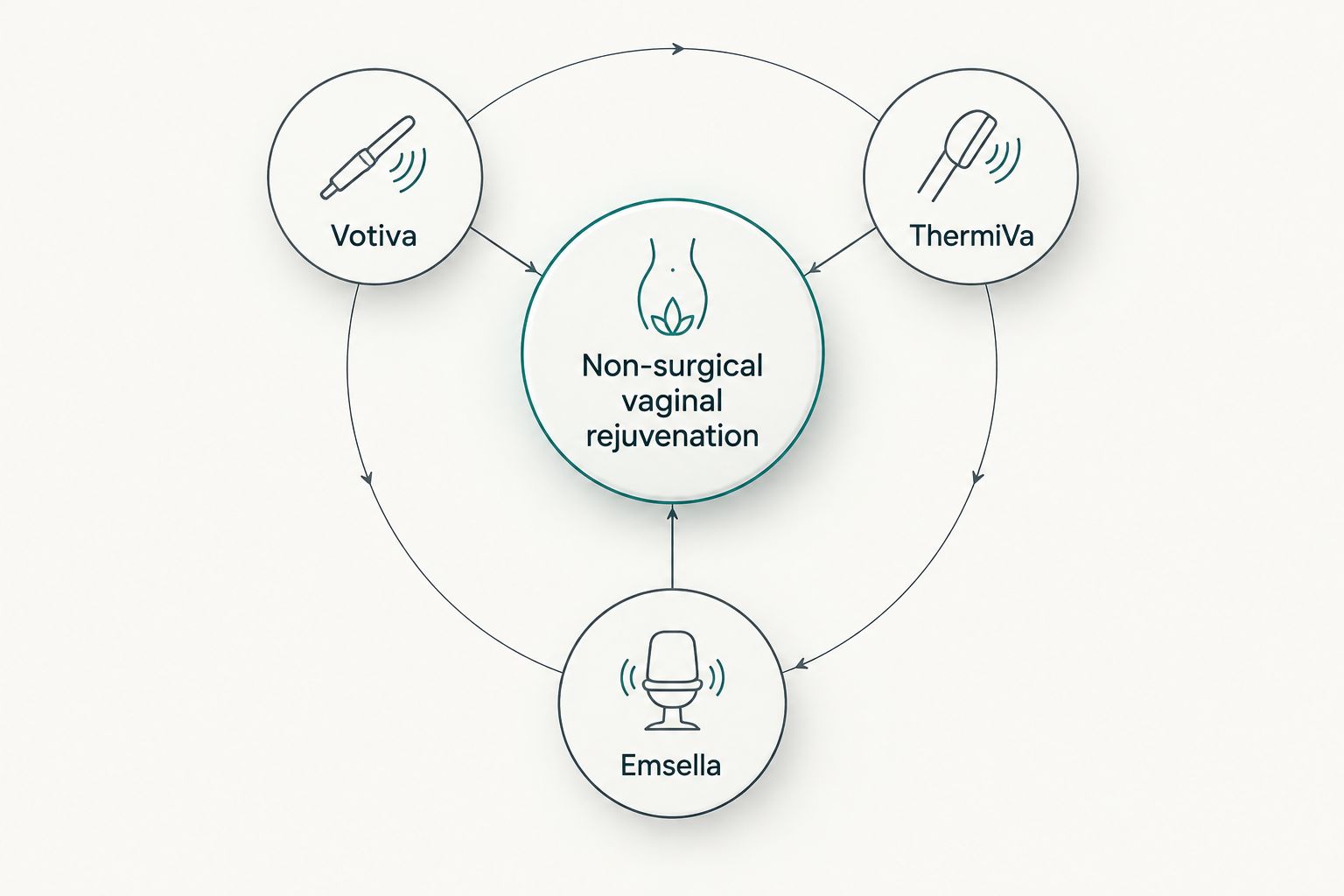
Best overall for postpartum vaginal laxity: Votiva. Best for external tissue comfort with zero downtime: ThermiVa. Best for stress urinary incontinence and bladder control: Emsella. Castellano Cosmetic Surgery Center's non-surgical vaginal rejuvenation treatments in Tampa cover all three, and the right pick in 2026 depends on which symptom actually bothers you.
- Votiva is the best non-surgical vaginal rejuvenation option in Tampa for postpartum laxity, using radiofrequency and heat over roughly three sessions.
- ThermiVa is the gentler radiofrequency option, better suited to mild laxity or external comfort than moderate-to-severe cases.
- Emsella treats bladder control through electromagnetic pelvic floor stimulation, a different mechanism than Votiva or ThermiVa.
- None of these three replace labiaplasty when the issue is excess tissue rather than laxity.
- All three are done in-office with no anesthesia and no downtime.
Why this matters
Non-surgical vaginal rejuvenation gets marketed as one category, but it actually covers three separate clinical problems: tissue laxity, external comfort or sensitivity, and stress urinary incontinence. Pregnancy, vaginal delivery, and menopause loosen or thin tissue in different ways, and the device that helps one symptom often does nothing for another.
That distinction matters more than the brand name on the machine. A patient asking about Votiva for bladder leakage is pointing the wrong device at the problem, and Emsella won't tighten loose tissue the way Votiva or ThermiVa can. Castellano Cosmetic Surgery Center treats these as separate clinical conversations rather than one generic menu item, because matching the mechanism to the symptom is what determines whether a patient sees a result in 2026.
What makes the best non-surgical vaginal rejuvenation treatment
- Mechanism matches the symptom. Radiofrequency (Votiva, ThermiVa) tightens tissue; electromagnetic stimulation (Emsella) rebuilds pelvic floor muscle.
- FDA clearance for the specific use. A device cleared for tissue coagulation isn't automatically cleared for incontinence, and vice versa.
- Session count and spacing. A protocol needing six visits over three weeks fits a calendar differently than one needing three visits a month apart.
- No anesthesia, no incision. Every option here is done in an exam chair, with no recovery time built in.
- Physician-led supervision. Treatments run under med spa oversight from a cosmetic surgery practice get closer monitoring of technique than a walk-in franchise.
- Complements, not replaces, surgery. None of these three treat excess or redundant tissue the way labiaplasty does.
Votiva vs ThermiVa vs Emsella at a glance
| Treatment | Best for | Standout feature | Key limitation |
|---|---|---|---|
| Votiva | Postpartum vaginal laxity | Combines radiofrequency with targeted heat for tissue tightening | Results build over a short session series, not immediately |
| ThermiVa | External tissue comfort, mild laxity | Lower-intensity radiofrequency, gentler starting point | Weaker effect on moderate-to-severe laxity than Votiva |
| Emsella | Stress urinary incontinence, bladder control | Electromagnetic pelvic floor muscle stimulation | Doesn't tighten vaginal tissue at all |
1. Votiva: best non-surgical vaginal rejuvenation for postpartum laxity
Votiva delivers radiofrequency energy through an external and internal handpiece, heating tissue to stimulate collagen and tighten it over the following weeks. It's the option most patients ask for after vaginal delivery, when laxity — not incontinence — is the complaint. The standard protocol runs 3 sessions spaced roughly a month apart, with no anesthesia and no built-in recovery time.
Votiva pros:
- Treats both internal and external tissue in the same session
- No anesthesia, no incision, normal activity resumes immediately
- Addresses laxity specifically, the symptom most postpartum patients report
Votiva cons:
- Results build gradually across the session series, not right away
- Doesn't address stress urinary incontinence
- Maintenance sessions are typically needed to hold the result
Votiva verdict: Buy — the strongest option on this list for tissue laxity after childbirth.
2. ThermiVa: best non-surgical vaginal rejuvenation for external tissue comfort
ThermiVa uses radiofrequency at a lower intensity than Votiva, mainly to warm external and vaginal tissue for comfort and mild tightening. It suits patients with mild laxity, sensitivity changes, or dryness-related discomfort who want a gentler starting point rather than a stronger first move.
ThermiVa pros:
- Gentler heat profile, useful for patients sensitive to more aggressive RF
- No anesthesia, no downtime
- Works as a reasonable starting point before deciding on a stronger option
ThermiVa cons:
- Weaker tightening effect on moderate-to-severe laxity than Votiva
- Doesn't treat incontinence
- More sessions may be needed to reach a result Votiva delivers in fewer visits
ThermiVa verdict: Hold — fine for mild symptoms, but patients with more pronounced laxity typically get more from Votiva.
3. Emsella: best non-surgical vaginal rejuvenation for bladder control
Emsella isn't a radiofrequency device. It uses high-intensity focused electromagnetic (HIFEM) technology to contract pelvic floor muscles thousands of times per session, the same muscles targeted by Kegel exercises. That makes it the right tool for stress urinary incontinence, not for tissue laxity. Patients sit fully clothed on the Emsella chair through a standard protocol of 6 sessions over three weeks.
Emsella pros:
- Fully clothed, no undressing, no anesthesia
- Strengthens pelvic floor muscle rather than heating tissue
- Addresses bladder control, a symptom the RF-based options don't touch
Emsella cons:
- Does nothing for vaginal tissue laxity
- Requires completing a fixed six-session series
- Best suited to mild-to-moderate stress incontinence, not severe cases
Emsella verdict: Buy — for bladder control specifically, this is the right device on this list.
How we ranked these three options
The ranking above sits on mechanism first, symptom match second. Votiva ranks highest overall because postpartum laxity is the most common complaint driving patients to ask about non-surgical vaginal rejuvenation in Tampa, and radiofrequency tightening is the direct answer to that complaint. ThermiVa ranks below it only because lower intensity means a smaller effect on the same symptom, not because the device does anything wrong. Emsella isn't ranked against the other two at all — it solves a different problem, and comparing it to Votiva on "which tightens better" misses what Emsella is built to do.
Find your fit for 2026
A consultation narrows down Votiva, ThermiVa, or Emsella to the symptom you actually have.
Which non-surgical vaginal rejuvenation option should you choose?
If postpartum laxity is the complaint, Votiva is the default choice in 2026 — it treats the symptom most patients report using an established radiofrequency protocol. Choose ThermiVa only if you want a gentler starting point or have mild symptoms you'd rather address conservatively first.
Emsella is the answer for bladder control, not a competitor to the other two — pick it when leaking with a cough, laugh, or workout is the actual concern, not tissue laxity.
None of these three treat excess or redundant vaginal tissue. If a consultation at Castellano Cosmetic Surgery Center points to a structural issue rather than laxity or muscle weakness, ask about labiaplasty instead — that's a surgical answer to a different problem, not a device on this list.
FAQ
What is the best non-surgical vaginal rejuvenation option in Tampa?
Votiva is the best non-surgical vaginal rejuvenation option in Tampa for postpartum vaginal laxity, based on its radiofrequency and heat delivery protocol. ThermiVa suits milder laxity, and Emsella is the right choice specifically for bladder control rather than tissue tightening.
Is ThermiVa or Votiva better for vaginal laxity?
Votiva delivers a stronger radiofrequency effect and tends to produce more noticeable tightening for moderate-to-severe laxity. ThermiVa works at a lower intensity and fits patients with mild symptoms or those who want a gentler starting point.
Does Emsella tighten vaginal tissue like Votiva does?
No. Emsella uses electromagnetic pelvic floor muscle stimulation to address bladder control and stress incontinence, not radiofrequency tissue tightening. It doesn’t produce the tightening effect Votiva or ThermiVa do.
How many sessions does non-surgical vaginal rejuvenation take?
Votiva and ThermiVa typically run about 3 sessions spaced roughly a month apart, while Emsella follows a 6-session protocol over three weeks. Counts vary by symptom severity and the device used.
Is there downtime after Votiva, ThermiVa, or Emsella?
None of the three require anesthesia, incisions, or recovery time. Patients typically return to normal activity, including exercise, right after each session.
Can non-surgical vaginal rejuvenation replace labiaplasty?
No. Votiva, ThermiVa, and Emsella address laxity, tissue comfort, or bladder control, not excess or redundant tissue. Labiaplasty is a surgical answer to a structural concern these options don’t treat.
Who should consider Emsella instead of Votiva?
Patients whose main complaint is leaking urine with coughing, laughing, or exercise should consider Emsella, since it targets pelvic floor muscle strength rather than vaginal tissue laxity. Votiva doesn’t address incontinence.
Are Votiva, ThermiVa, and Emsella FDA-cleared?
Votiva and ThermiVa are radiofrequency devices cleared for tissue treatment such as vaginal rejuvenation, and Emsella is cleared for pelvic floor muscle stimulation to address stress urinary incontinence. Clearance is specific to the symptom each device targets.
One last thing
The most common mistake patients make in 2026 isn't picking the wrong device — it's assuming one device treats every symptom. A patient who wants both tighter tissue and better bladder control usually needs Votiva or ThermiVa for laxity and Emsella for incontinence, run as two separate protocols, not one combined treatment plan sold under a single "vaginal rejuvenation" label.
Related guides

Author: Dr. Joseph Castellano
Dr. Joseph Castellano is a native Floridian who grew up in the Tampa Bay area. After medical school and residency, Dr. Castellano returned home and has opened a practice in Tampa, Florida focusing on breast augmentation, abdominoplasty, liposuction, facelift, and eyelid rejuvenation. He is a member of the American Board of Cosmetic Surgery, American College of Surgeons, and American Medical Association