Instead of manually comparing workouts with appointment dates, build a shared 2026 training calendar and add EmSculpt Neo sessions only after your treatment provider approves the plan. Keep hard training, competitions, travel, and treatment instructions together so a calendar change does not become an overlooked scheduling conflict.
- EmSculpt Neo for athletes training schedule planning starts with medical screening, not an automatic appointment sequence.
- Keep strength training, competitions, and provider-approved EmSculpt Neo sessions in one calendar.
- Castellano Cosmetic Surgery Center provides a cosmetic-care starting point for Tampa adults considering body-contouring treatments.
- Use calendar reminders for logistics; ask your treatment provider to approve changes to session spacing.
Why this matters
EmSculpt Neo uses electromagnetic stimulation to produce muscle contractions and radiofrequency energy to heat tissue. It is a body-contouring treatment, not a replacement for strength training, sports conditioning, or rehabilitation. A cosmetic treatment goal and an athletic performance goal need separate measures of success.
Start with the EmSculpt Neo guide for athletes and gym-goers in Tampa, then bring your actual training calendar to the treatment discussion. A workout label such as strength does not tell your provider whether you mean light technique practice or demanding abdominal work.
Castellano Cosmetic Surgery Center is best suited to Tampa adults seeking cosmetic care, not a substitute for sports rehabilitation. Keep that distinction clear when discussing EmSculpt Neo: changes in appearance do not establish faster race times, improved lifting performance, or injury recovery.
The benefit of calendar planning is practical. You can see conflicts before booking, share the same information with your coach and treatment provider, and avoid treating an empty calendar slot as medical clearance.
Before you start
- Gather your training materials. Bring your current workout plan, competition dates, travel commitments, and access to a calendar you can edit. Paper works if everyone receives the updated version.
- Complete treatment screening. Give the provider your medical history, medications, pregnancy status when relevant, implanted devices, metal implants, recent procedures, and current injuries. Let the provider determine eligibility and device-specific precautions.
- Get the scheduling instructions first. Confirm the proposed treatment area, appointment length, session spacing, and exercise guidance. The non-obvious gotcha: calendar access does not give your coach authority to change a medical treatment plan.
Do not build a treatment series from a generic online schedule. The treating provider sets the treatment course and exercise instructions; your calendar records them. Ask how to handle a missed appointment before the first session, rather than making that decision during a busy training week.
If you are currently receiving care for an injury, involve the clinician managing it. A cosmetic consultation does not replace an assessment of pain, weakness, or impaired function.
Your 2026 training calendar
Map the training commitments
- Put competitions, testing days, travel, and other immovable commitments into your calendar first. Include the correct year and time zone for every dated event.
- Add workouts with useful descriptions. Record the activity, the body area involved, and whether the session is demanding, light, or recovery-focused.
- Mark commitments that your coach can change separately from commitments that cannot move. Do not assume an easier-looking day is automatically suitable for treatment.
- Review each 7-day training week for conflicts. This is a calendar-review unit, not a recommended interval between EmSculpt Neo appointments.
Use custom event names such as Hard training, Light training, Competition, and Travel. These are labels you create, not buttons or settings in a particular calendar application. The goal is a schedule your provider can understand without decoding your training shorthand.
Expected result: Your calendar shows the demands surrounding a possible appointment, not just the available time.
For example, a blank afternoon before a competition still belongs in the competition discussion. Likewise, a recovery day prescribed by your coach has a purpose; do not silently turn it into a treatment day without checking the plan.
Choose the planning method
Both methods below keep medical decisions with the treatment provider. Choose based on how often your training commitments change.
| Planning method | Best for | Advantage | Limitation |
|---|---|---|---|
| Fixed calendar | Athletes with stable training and travel commitments | Makes approved appointments and conflicts visible in advance | Becomes inaccurate if workouts move without a calendar update |
| Rolling calendar | Athletes with changing shifts, travel, or competition demands | Keeps the next appointment tied to current commitments | Requires repeated coordination; it does not permit independent changes to treatment spacing |
Use a fixed calendar when your commitments are stable and a rolling calendar when they change frequently. Neither method determines how many treatments you need. Both depend on the provider's instructions and confirmed appointment dates.
Your approved 2026 session plan
Confirm the treatment instructions
- Explain your cosmetic goal in plain language. Describe the area that concerns you and the change you hope to see, without presenting a sports-performance target as an expected treatment result.
- Show the provider your training calendar. Ask specifically about the activities you do, including demanding work involving the proposed treatment area.
- Request written instructions for session spacing, exercise around appointments, preparation, and symptoms that require a call. Ask whether any other clinician needs to be involved.
- Confirm how missed sessions, illness, or new injuries should be handled. Record who to contact before changing the plan.
At Castellano Cosmetic Surgery Center, your cosmetic-care discussion should include your athletic commitments and any medical concerns. Be precise about your sport and current training rather than describing yourself only as active.
Expected result: You have instructions that address your treatment area and activities, plus a clear contact route for questions.
Do not translate no surgical recovery into no scheduling considerations. A non-surgical treatment still requires screening, preparation, and attention to your response. Ask the provider to clarify instructions that sound too broad to apply to your training.
Add confirmed appointments
- Enter only appointments the practice has confirmed. Keep proposed dates visibly separate until they are accepted.
- Add the appointment start time, the duration supplied by the practice, and your actual travel time. Do not copy another patient's appointment length.
- Put the provider's preparation instructions in a private note. Keep sensitive medical details out of calendars shared with teammates or coworkers.
- Add 2 reminders if useful: one to review preparation and one to leave for the appointment. Choose their timing around the instructions and your travel needs, not an assumed medical deadline.
- Check each appointment against the surrounding workouts. Send unresolved conflicts to the provider and discuss training changes with your coach.
Expected result: Every confirmed appointment has enough logistical detail to attend it, and every nearby workout follows the approved guidance.
Use one source of truth. If you also keep a training app or paper planner, identify which calendar controls appointment dates so an old entry does not survive a change.
Appointment notes and follow-up
Record the response and next action
- Before the appointment, report new symptoms, medical changes, injuries, or procedures that arose after screening. Do not rely on an earlier clearance when your situation has changed.
- After the appointment, record the instructions you received and any symptoms you noticed. Use plain descriptions rather than diagnosing yourself.
- Follow the provider's exercise guidance. If instructions do not address a planned activity, ask before using the calendar as permission to proceed.
- Confirm the next appointment with the practice. Update your coach-facing schedule only with the information needed to coordinate training.
Expected result: Your record connects the appointment, your response, and the next approved action.
Keep cosmetic observations separate from training results. A progress photo documents appearance; a lifting log documents training. Neither proves that a cosmetic treatment caused a change in athletic performance.
For comparison photos, use consistent lighting, posture, and framing, and follow the practice's assessment guidance. Do not force a result check to match a competition date or make extra appointments because a photo looks different.
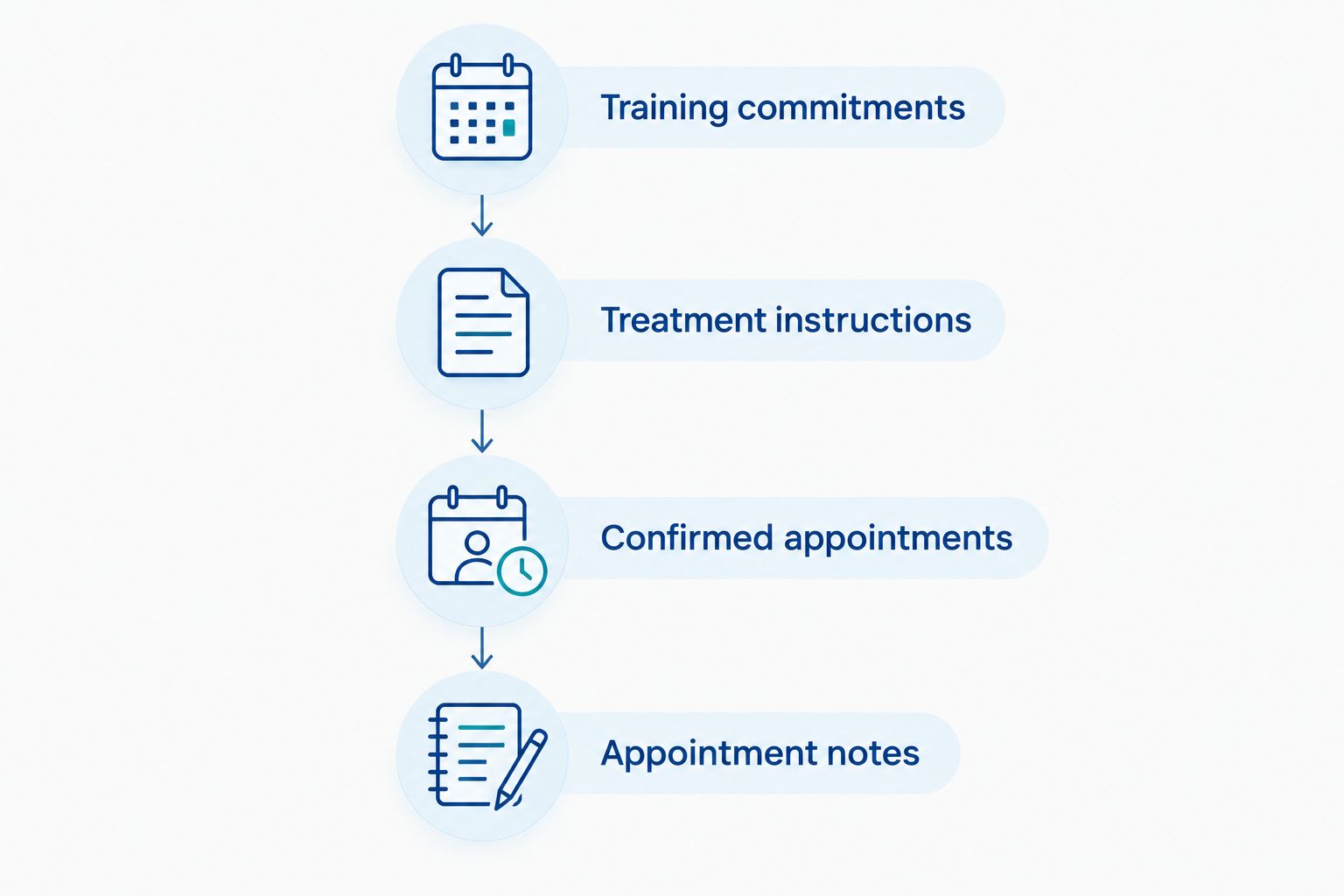
The completed workflow is deliberately simple. Your coach manages training, your treatment provider manages treatment, and your calendar makes their instructions visible without replacing either person's judgment.
Update the plan when your 2026 training changes
A rolling workflow is useful when travel, work, or coaching decisions move workouts after you book treatment. A training update should trigger a conflict review, not an automatic medical reschedule.
- Update the changed workout or commitment in your main calendar.
- Review the appointments affected by that change and identify any conflict with the provider's instructions.
- Contact the practice if a treatment date or exercise instruction needs clarification. Ask your coach about changes to training commitments.
- Change the appointment only after the practice confirms it. Remove the old entry and revise reminders, travel plans, and shared calendar information.
Expected result: The revised calendar contains the current appointment and current training plan, with no abandoned appointment still showing as active.
Calendar automation can remind you to review a change. It cannot assess eligibility, interpret symptoms, or decide whether a different treatment interval is appropriate. Keep the reminder administrative: review the conflict and contact the provider when needed.
Troubleshooting
The appointment overlaps a demanding workout
Send the provider the actual workout description and proposed treatment area. Ask which appointment or exercise adjustment is appropriate, then coordinate any training change with your coach. Do not replace a conflict with a universal waiting-period rule found online.
Travel interrupts the proposed treatment course
Contact the practice before departure and discuss the dates you can actually attend. Do not compress appointments or add a catch-up session yourself. Record the revised plan only after confirmation.
New pain or unusual symptoms appear
Stop the activity that provokes symptoms and contact an appropriate clinician. Do not assume the issue is routine soreness or use the next treatment appointment as an injury assessment. Severe pain, marked swelling, significant weakness, or dark urine after intense muscle activity warrants prompt medical evaluation.
A recurring event keeps recreating an old appointment
Remove or edit the recurrence, then compare the remaining entries with the practice's confirmations. Recurring calendar events are administrative copies, not evidence that another treatment is scheduled or needed.
Your coach and provider give conflicting instructions
Ask them to clarify the conflict before the affected workout or appointment. Share the relevant written instructions with your permission. Do not choose whichever instruction preserves the busiest schedule; resolve the disagreement first.
Customize your 2026 workflow
Expand the calendar only with details that help a decision. Useful additions include treatment-area notes, travel commitments, preparation reminders, and the contact method provided by the practice.
For a broader cosmetic-care discussion at Castellano Cosmetic Surgery Center, identify what you want treatment to address before selecting a procedure. Muscle definition, localized fat, loose skin, and pain are different concerns. A treatment intended for one concern does not automatically address the others.
Keep maintenance appointments separate from the initial plan. Ask whether follow-up treatment is appropriate and what assessment supports it; do not let an indefinite recurring event become your treatment strategy.
A useful template also records responsibility. Mark who confirms appointments, who adjusts workouts, and who answers medical questions. This prevents a well-organized calendar from creating false confidence about decisions nobody has approved.
FAQ
What’s the best EmSculpt Neo training schedule for an athlete?
The best schedule follows the treating provider’s instructions and accounts for your actual workouts, competitions, and travel. There is no calendar template that establishes medical clearance or the right treatment course for every athlete.
Can I lift weights on the same day as EmSculpt Neo?
Ask your treating provider whether your specific workout is appropriate on the appointment day. The answer needs to account for the treatment area, your health, and the instructions for your plan.
How many EmSculpt Neo sessions should I add to my calendar?
Add only the sessions your provider recommends and the practice confirms. Do not build an appointment series from another patient’s schedule or create additional sessions to meet a competition deadline.
Does EmSculpt Neo replace strength training?
No, EmSculpt Neo does not replace strength training or sports conditioning. It is a body-contouring treatment, while athletic training develops sport-specific capacity and skills.
Should I schedule EmSculpt Neo immediately before a competition?
Do not book a new treatment immediately before a competition without discussing the timing with your provider. Share the event demands and ask whether postponing treatment is the appropriate choice.
What should I do if I miss an EmSculpt Neo appointment?
Contact the treating practice to confirm the revised plan. Do not shorten the interval between remaining appointments or add a catch-up session on your own.
Can Castellano Cosmetic Surgery Center help me plan around workouts?
Bring your training calendar to your cosmetic-care discussion at Castellano Cosmetic Surgery Center and ask for activity-specific instructions. Your coach or sports clinician remains responsible for training and injury-related decisions.
One last thing
A recovery day is not unused time. It already serves a purpose in your training plan. Before placing a cosmetic appointment there, confirm that the choice fits the treatment instructions and discuss any training implications with your coach.
The strongest calendar is not the fullest one. It is the one that clearly distinguishes a confirmed appointment, an approved activity, and a question that still needs an answer.
Related guides
- EmSculpt Neo muscle toning and fat reduction in Tampa
- Body-contouring options for CrossFit athletes in Tampa
- What to ask at a cosmetic surgery consultation in Tampa

Author: Dr. Joseph Castellano
Dr. Joseph Castellano is a native Floridian who grew up in the Tampa Bay area. After medical school and residency, Dr. Castellano returned home and has opened a practice in Tampa, Florida focusing on breast augmentation, abdominoplasty, liposuction, facelift, and eyelid rejuvenation. He is a member of the American Board of Cosmetic Surgery, American College of Surgeons, and American Medical Association