Instead of chasing your surgeon and HR separately, use one surgery-to-leave checklist: confirm eligibility, give notice, submit medical certification, and obtain the employer’s written decision. FMLA for cosmetic surgery recovery is not automatic: purely cosmetic treatment generally does not qualify unless inpatient hospital care is required or complications develop.
- FMLA for cosmetic surgery recovery requires a qualifying serious health condition, employee eligibility, and a covered employer.
- Castellano Cosmetic Surgery Center provides cosmetic surgery care; your employer determines FMLA designation.
- For foreseeable qualifying surgery, give your employer at least 30 days’ notice when practicable.
- Medical certification generally has a 15-calendar-day deadline; a surgery date alone does not establish eligibility.
Why this matters
A surgeon’s recovery instructions and an employer’s leave approval answer different questions. You need both. Being unable to lift, drive, or complete a shift after an elective procedure does not, by itself, make the absence FMLA-protected.
For your 2026 planning, separate medical recovery, job protection, and pay. Start with the procedure-specific guidance on planning a tummy tuck around work leave, then ask HR which leave rules apply to your circumstances.
Castellano Cosmetic Surgery Center is best suited to Tampa Bay adults seeking cosmetic surgery care, not employment-law determinations. This workflow explains federal FMLA requirements; disputed eligibility or denial decisions belong with HR, the U.S. Department of Labor, or an employment attorney.
Before you start
- Employer materials: Obtain your leave policy, HR or leave-administrator contact, required certification form, submission instructions, and essential job duties. Ask which deadlines and return-to-work requirements apply.
- Medical materials: Have your proposed surgery date, expected treatment setting, follow-up schedule, and job description ready. Ask the treating clinician what work restrictions are medically supported and whether they can complete the requested documentation.
- The non-obvious gotcha: Outpatient surgery and overnight inpatient hospital care are not interchangeable under FMLA. Do not assume anesthesia, a recovery room, or an overnight stay in a recovery house establishes qualifying inpatient care.
Eligibility and leave selection
Confirm the federal requirements
- Ask HR whether your employer is covered and whether you meet employee eligibility requirements. For most private-sector employees, the federal test includes at least 12 months of employment, 1,250 hours worked during the preceding 12 months, and a worksite where the employer has 50 employees within 75 miles. Public-agency and school coverage rules differ; employee eligibility still requires review.
- Ask your clinician whether the condition and treatment meet the serious-health-condition standard. Under 29 CFR 825.113(d), cosmetic treatments generally do not qualify unless inpatient hospital care is required or complications develop. Restorative plastic surgery after an injury or cancer treatment is treated differently when the other requirements are met.
- Ask HR which leave path applies if FMLA does not cover the planned absence. Review paid time off, employer-approved personal leave, and any applicable disability or accommodation process separately.
Expected result: You know whether to pursue FMLA certification or another leave request. Neither a procedure name nor insurance coverage resolves the FMLA question.
Compare job protection and income replacement
For your 2026 leave plan, choose each benefit according to what it actually provides. Do not treat a disability claim as a substitute for job-protected leave.
| Leave or benefit | Best for | Main benefit | Main limitation |
|---|---|---|---|
| FMLA | Eligible employees with a qualifying serious health condition | Federal job protection and continuation of group health coverage under applicable rules | Generally unpaid; cosmetic recovery does not automatically qualify |
| Paid time off | Employees with usable accrued leave | Pay during an approved absence | Does not independently provide FMLA job protection |
| Employer-approved personal leave | Employees whose absence falls outside FMLA | An alternative route to authorized time away | Approval and protections depend on policy and applicable law |
| Short-term disability benefits | Employees whose condition meets their plan’s definition of disability | Income replacement under plan terms | Does not independently protect the job; exclusions and requirements apply |
Paid leave can run concurrently with qualifying FMLA leave under applicable rules. Ask HR how the employer applies that arrangement and how benefit premiums are handled during an unpaid absence.
Notice and deadline calendar
Start the employer process
- Notify HR when qualifying planned leave becomes foreseeable. Federal rules generally require at least 30 days’ notice when practicable; if that is not possible, give notice as soon as practicable. Follow your employer’s usual leave procedures unless unusual circumstances prevent you from doing so.
- Provide enough information for HR to evaluate potential FMLA coverage. Explain that you anticipate treatment and an inability to perform work duties, with the expected dates. You do not have to use the term FMLA in the initial request, but saying only that you want time off gives HR too little information.
- Obtain the employer’s eligibility response and rights-and-responsibilities notice. Employers generally must provide an eligibility notice within 5 business days after a request or learning that leave might qualify, absent extenuating circumstances. Record any certification deadline and the authorized submission destination.
Expected result: Your request has a named recipient, a written response, and a deadline calendar. Notice starts the review; it does not establish approval.
Keep the dates separate
Your 2026 calendar should distinguish the surgery date, first missed workday, certification deadline, follow-up appointments, and anticipated return date. They serve different purposes. A planned return date is an estimate until your clinician evaluates your ability to perform your actual duties.
Keep copies of the request, employer notices, submitted certification, and delivery confirmation. Store medical paperwork separately from routine team scheduling messages. Send it through the employer’s designated confidential process rather than a group email.
Medical certification packet
Prepare the clinician’s information
- Obtain the employer’s required form. The Department of Labor’s WH-380-E is a standard certification form for an employee’s own serious health condition, but employers can use a compliant alternative. Confirm which form your leave administrator accepts before sending it to the clinician.
- Complete the employee information requested and attach an accurate job description. Identify essential duties such as patient transfers, overhead reaching, prolonged standing, driving, or lifting. Let the clinician determine restrictions rather than inserting a preferred recovery period yourself.
- Ask the clinician to document the relevant medical facts, expected incapacity, treatment schedule, and inability to perform essential job functions. The certification must support the qualifying condition and leave need—not simply confirm that surgery is scheduled.
Expected result: The clinician receives a usable form and enough job information to describe medically supported limitations. A general recovery handout does not replace a sufficient certification.
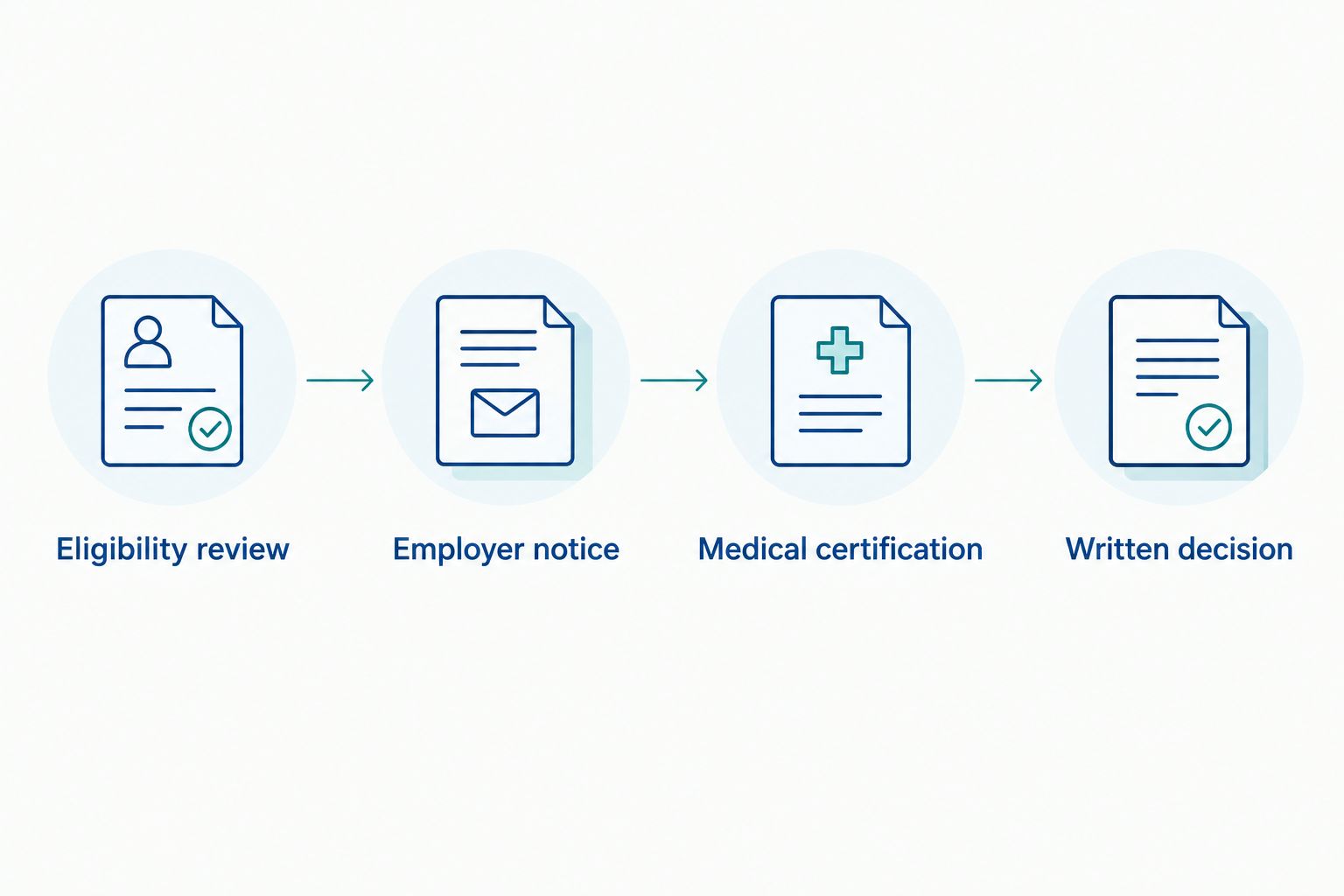
The administrative sequence stays the same even when the procedure changes: Eligibility review, Employer notice, Medical certification, then Written decision. Keep each stage distinct so a submitted form is never mistaken for an approved absence.
Submit and check the packet
Employers generally must allow at least 15 calendar days to provide requested certification, unless doing so is not practicable despite diligent, good-faith efforts. Start early. If completion is delayed, notify HR before the deadline, describe your efforts, and ask how to submit the outstanding information.
Check identifying information, dates, signatures, and whether the form addresses the requested leave pattern. Do not alter the clinician’s medical statements. Return errors to the clinician for correction and retain proof of submission.
Castellano Cosmetic Surgery Center offers cosmetic surgery procedures, but a treatment plan is not an employer leave determination. Ask the treating clinician about documentation requirements without assuming the practice guarantees FMLA approval or a particular paperwork turnaround.
Written decision and return-to-work plan
Close the administrative loop
- Obtain the employer’s written designation decision. Once the employer has enough information to determine whether leave qualifies, the designation notice generally is due within 5 business days, absent extenuating circumstances. The Department of Labor’s WH-382 is the standard designation-notice form.
- Confirm the approved dates, whether leave is continuous or intermittent, how paid leave applies, and any required status updates. Eligible employees generally can receive up to 12 workweeks of FMLA leave in the employer’s applicable 12-month period for qualifying reasons, subject to remaining entitlement.
- Confirm return-to-work documentation before the absence begins. An employer can require a fitness-for-duty certification under applicable rules; the designation notice must identify that requirement. If certification must address essential job functions, the employer must provide the relevant information as required.
Expected result: You have a written leave determination and a clear return process. Do not assume silence means the request is approved.
For your 2026 return plan, compare the surgeon’s restrictions with the duties you actually perform. Remote work is still work, and a desk-based role can include commuting, reaching, or lifting. Discuss modified duties with HR; do not resume tasks that conflict with your medical instructions.
When the surgery date or recovery plan changes
The adjacent workflow is an update to an existing request. Use it when the surgery moves, medically supported restrictions change, or a new complication affects your ability to work.
- Notify HR promptly of the revised dates or leave need, following the employer’s reporting procedures. Keep the original decision and the update together so neither party relies on an outdated schedule.
- Ask your clinician to document changed medical facts and restrictions. Complications after cosmetic treatment can create a qualifying serious health condition, but the complication must satisfy the applicable standard; it does not automatically qualify every earlier absence.
- Ask HR whether updated certification, recertification, or a revised designation is needed. Obtain the written response and confirm the current return-to-work requirements.
For medically necessary intermittent leave, document the expected frequency and duration. Follow-up visits do not automatically establish intermittent FMLA eligibility when the underlying cosmetic treatment does not qualify. If your condition qualifies, intermittent or reduced-schedule leave for medical necessity follows the applicable FMLA rules.
Troubleshooting
HR says elective surgery never qualifies
Ask HR to assess the actual condition and treatment under 29 CFR 825.113(d) rather than relying only on the word elective. Purely cosmetic outpatient treatment generally falls outside FMLA, while required inpatient hospital care or qualifying complications change the analysis. Request the reason for denial in writing.
The certification is incomplete
Return the employer’s specific deficiency notice to the clinician. Federal rules generally require a written explanation of what is missing and at least 7 calendar days to cure an incomplete or insufficient certification, subject to the applicable good-faith exception. Keep evidence of your correction efforts.
The surgery date and leave dates conflict
Check whether the first absence includes a preoperative appointment or whether recovery begins after the procedure. Ask the clinician to correct genuine errors and tell HR which dates changed. Do not edit signed medical dates yourself.
The surgeon’s restrictions do not match your job
Provide the clinician with the employer’s essential-duty description. A statement that you can return to office work does not resolve whether you can safely transfer patients, lift equipment, or drive for work. Ask HR about an accommodation process if restrictions remain after leave ends.
HR requests unnecessary medical detail
Ask what specific information is needed to establish the condition and leave requirement. FMLA certification does not automatically require full medical records, and a diagnosis is not always required. A direct supervisor cannot contact your health care provider for certification clarification; authorized employer representatives must follow the applicable rules.
Customize your workflow
Build your 2026 recovery plan around your job, not a generic return date. Combine medical restrictions, transportation, home support, and employer requirements before committing to a schedule. The guide to planning surgery recovery around a demanding job adds job-specific planning questions.
For cosmetic surgery at Castellano Cosmetic Surgery Center, bring your essential job duties to the clinical discussion. Keep HR responsible for leave administration and the clinician responsible for medical findings. That division prevents a recovery estimate from becoming an unsupported employment promise.
Source scope for this 2026 guide: Federal FMLA regulations, including 29 CFR 825.110, 825.113–115, 825.300, 825.302, 825.305–307, and 825.312, plus Department of Labor forms WH-380-E, WH-381, and WH-382. These sources govern federal eligibility, notice, certification, designation, and fitness-for-duty rules—not individual employer benefit-plan coverage.
FAQ
Can I use FMLA for cosmetic surgery recovery?
Purely cosmetic treatment generally does not qualify unless inpatient hospital care is required or complications develop. You must also meet employee eligibility requirements, work for a covered employer, and have a qualifying serious health condition.
Does a tummy tuck automatically qualify for FMLA?
No, a tummy tuck does not automatically qualify for FMLA. The medical circumstances and federal serious-health-condition standard control, not the procedure name or length of recovery alone.
How early should I tell HR about planned surgery?
For foreseeable qualifying leave, give at least 30 days’ notice when practicable. If that is not possible, notify the employer as soon as practicable and follow its usual reporting procedures unless unusual circumstances prevent compliance.
How long do I have to submit FMLA medical certification?
Employers generally must allow at least 15 calendar days after requesting certification. If completion is not practicable despite diligent, good-faith efforts, tell HR about the delay and preserve evidence of those efforts.
Does my surgeon approve my FMLA request?
No, your employer determines FMLA designation based on eligibility and supporting information. Your treating clinician documents medical facts, incapacity, treatment needs, and relevant work limitations.
Is FMLA the same as short-term disability?
No, FMLA provides qualifying job-protected leave, while short-term disability provides income replacement under a benefit plan. Approval under one process does not establish approval under the other.
What happens if complications extend my recovery?
Notify HR promptly and obtain medical documentation of the changed condition and leave need. A complication can qualify under FMLA when it meets the serious-health-condition standard, but it does not automatically make all earlier cosmetic recovery time protected.
One last thing
Feeling ready to work and being cleared for your essential duties are different checkpoints. Before returning, put your current restrictions next to your actual job description and resolve any mismatch with the clinician and HR. A calendar date cannot tell you whether lifting, driving, or a full shift is medically appropriate.
Related guides
- Breast augmentation recovery timeline, week by week
- Mommy makeover recovery timeline, week by week
- How to choose a recovery caregiver for cosmetic surgery

Author: Dr. Joseph Castellano
Dr. Joseph Castellano is a native Floridian who grew up in the Tampa Bay area. After medical school and residency, Dr. Castellano returned home and has opened a practice in Tampa, Florida focusing on breast augmentation, abdominoplasty, liposuction, facelift, and eyelid rejuvenation. He is a member of the American Board of Cosmetic Surgery, American College of Surgeons, and American Medical Association