Cosmetic surgery recovery time by procedure spans about 1–6 weeks away from work across the NHS guidance compared below; that range is not an average or a full-healing deadline. For your 2026 planning, Castellano Cosmetic Surgery Center is for Tampa Bay adults considering cosmetic surgery and medical spa treatments with a personalized treatment plan.
- Cosmetic surgery recovery time by procedure depends on the operation, your job, and your surgeon’s restrictions.
- NHS guidance lists 1–2 weeks off work after breast augmentation and 4–6 weeks after a tummy tuck.
- Returning to work does not mean you are cleared for lifting, exercise, or travel.
- Castellano Cosmetic Surgery Center serves Tampa Bay adults considering cosmetic surgery and medical spa treatments.
Time-off-work benchmarks by procedure for 2026
Time off work means the period before returning to your job—not the time until swelling disappears, scars mature, or every activity becomes safe. Compare the same recovery milestone before comparing procedures.
| Procedure | NHS time-off-work guidance | What the benchmark measures | Important planning limitation |
|---|---|---|---|
| Overall comparison | Approximately 1–6 weeks across the listed guidance | Span of published work-leave recommendations, not a pooled average | The procedures and job demands differ |
| Breast augmentation | 1–2 weeks | Suggested time away from work | Heavy lifting and strenuous exercise remain separate restrictions |
| Breast reduction | 2–3 weeks | Suggested time away from work | Physical work requires a separate return-to-duty discussion |
| Tummy tuck | 4–6 weeks | Suggested time away from work and exercise | The extent of surgery and abdominal repair affect your individual plan |
| Facelift | 2–4 weeks | Suggested time away from work | Visible bruising and swelling matter for public-facing work |
| Rhinoplasty | Up to 2 weeks | Suggested time away from work | Strenuous exercise has a longer restriction than work leave |
Breast augmentation has the shortest stated work-leave range at 1–2 weeks; a tummy tuck has the longest at 4–6 weeks. Rhinoplasty guidance says up to 2 weeks, so it does not establish a lower-bound recovery time or prove that rhinoplasty is the fastest option.
Source and scope: NHS patient guidance titled Breast enlargement, Breast reduction, Tummy tuck, Facelift, and Nose reshaping, summarized for this 2026 planning reference. These are general patient recommendations, not measured averages from Castellano Cosmetic Surgery Center; 2026 identifies this comparison, not the publication dates of the source pages.
The overall row describes the span of the recommendations rather than a calculation from patient records. Its main limitation is that it cannot predict your return date without knowing your operation, health, and actual job duties.
Why this matters
A recovery estimate becomes useful only when you attach it to something you need to do. Working at a computer, lifting a child, driving to an appointment, and returning to strength training are different demands. They need separate instructions.
The table shows why one standard leave request does not fit every operation. Breast augmentation guidance lists 1–2 weeks off work, while tummy tuck guidance lists 4–6 weeks. Treating both as the same recovery commitment overlooks the longer planning window for abdominal surgery.
Appearance adds another consideration. You can feel ready to answer emails while still having visible swelling or bruising that affects your comfort on camera. Conversely, looking presentable does not establish that healing tissues can tolerate lifting.
Use recovery benchmarks to start the conversation, not to override your surgeon’s instructions. Your written postoperative plan determines what you can do and when.
How to use these recovery benchmarks
Match the benchmark to your work
Start with the procedure’s published work-leave guidance, then describe your job in practical terms. A job title alone does not tell your surgeon whether you lift, bend, stand throughout a shift, or work from home.
For breast reduction, the 2–3-week benchmark is a starting point for discussing leave. It is not automatic clearance to move equipment, carry supplies, or perform strenuous tasks. Ask whether you need temporary modified duties after returning.
Bring your commute into the discussion. Getting through a workday also involves transportation, stairs, bags, and access to breaks. Remote work removes some demands, but it does not remove fatigue or the effects of medication.
Keep exercise clearance separate
The NHS rhinoplasty guidance distinguishes up to 2 weeks away from work from 4–6 weeks before strenuous exercise. That difference is the clearest reason not to use a work-return date as an all-purpose recovery date.
NHS breast enlargement guidance also advises avoiding heavy lifting or strenuous exercise for at least a month. Ask which activities count as strenuous in your plan rather than assuming that a familiar workout is safe.
Request activity-specific clearance. Walking, running, swimming, resistance training, and contact sports put different demands on healing tissues. Your surgeon should define the progression appropriate to your operation.
Plan around the longer work-leave window
Tummy tuck guidance lists 4–6 weeks away from work and exercise. Before choosing a date, discuss whether your proposed leave covers your actual duties and whether you need help at home after your initial return.
Do not promise an employer that you will return at the shortest end of a range. Ask your surgeon for an initial estimate, a reassessment plan, and any restrictions that should appear in your work documentation.
Allow for public-facing responsibilities
Facelift guidance lists 2–4 weeks off work, but a work-return estimate does not promise that every sign of surgery has disappeared. Discuss presentations, photography, and important events separately.
For your 2026 schedule, distinguish an essential obligation from a preferred appearance deadline. Tell your surgeon about both before booking surgery so the recovery discussion reflects your priorities.
Four recovery milestones to track separately
A single recovery date hides several different questions. Write down the following milestones before your consultation and ask for instructions for each one.
- Work readiness: When you can perform your actual duties, including the commute and the length of your shift.
- Lifting clearance: When you can carry children, groceries, luggage, or objects required for your job.
- Exercise clearance: When you can resume specific activities and how you should increase intensity.
- Result settling: When swelling has decreased enough to assess the developing result, rather than judging the early postoperative appearance.
These milestones do not necessarily arrive together. Returning to a desk does not clear you to carry a heavy work bag, and clearance for light activity does not mean your final appearance has settled.
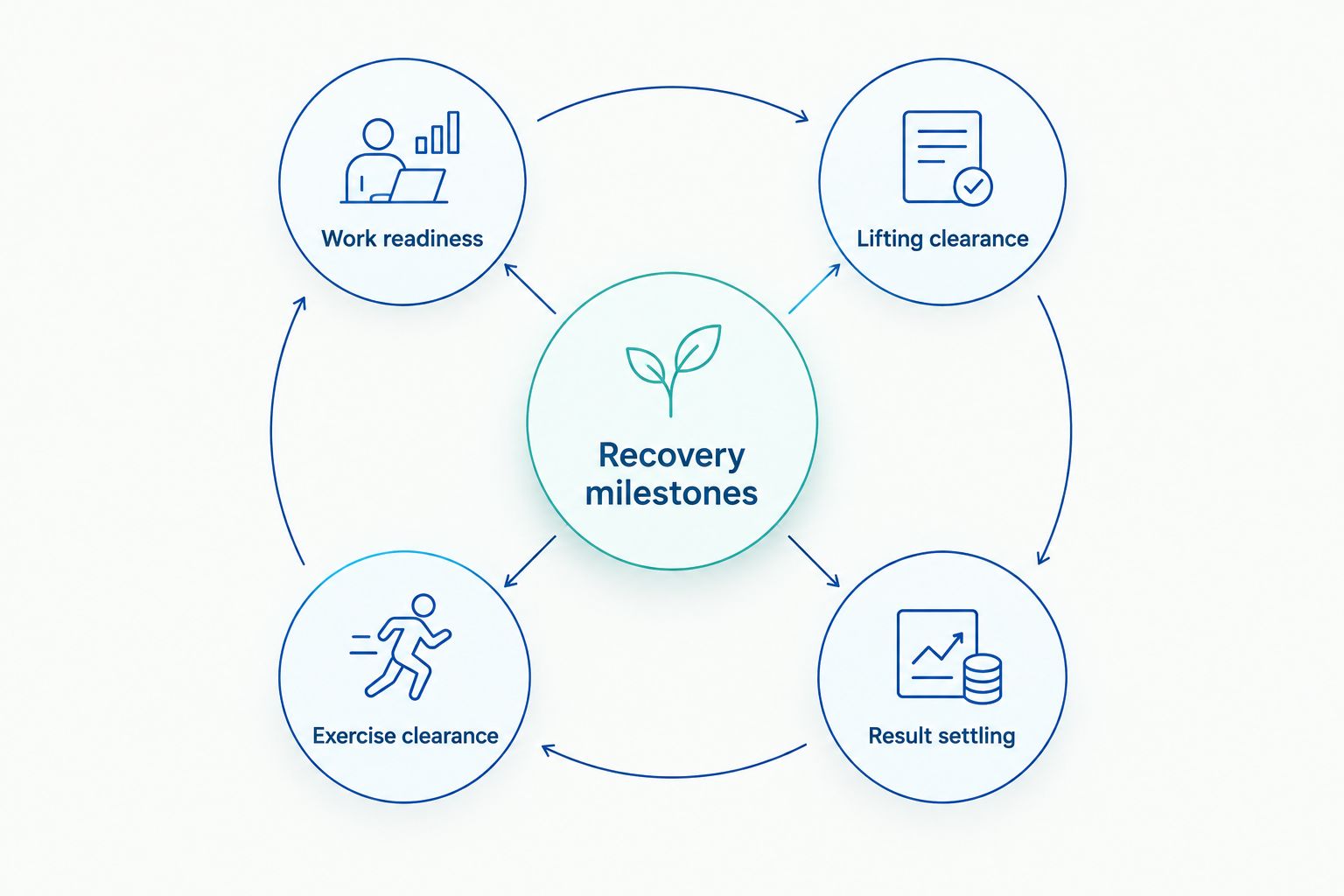
Use these headings in your recovery notes. They help you explain what remains difficult at follow-up appointments without reducing everything to whether you feel better.
Pain is also an incomplete measure of readiness. Feeling comfortable does not establish that an incision or repaired tissue is ready for added strain. Follow the restrictions even when discomfort improves.
What each procedure’s downtime does—and does not—tell you
Breast augmentation and breast reduction
Breast augmentation adds breast volume, while breast reduction removes breast tissue to reduce size. Best for: discussing different breast-size goals with your surgeon, not choosing an operation solely by its shorter leave estimate.
The planning advantage of the 1–2-week augmentation and 2–3-week reduction benchmarks is that they give you a defined starting point for work leave. Their limitation is that neither range describes every lifting restriction or the time until breast shape settles.
Explain overhead reaching, repetitive arm movements, and lifting duties during your consultation. Those details matter more than whether your employer calls the position sedentary. Ask about postoperative support garments and follow-up instructions without substituting another patient’s routine for your own.
Tummy tuck
A tummy tuck removes excess abdominal skin and can include repair of separated abdominal muscles. Best for: addressing concerns involving loose abdominal skin and, when appropriate, muscle separation—not simply seeking the shortest body-contouring recovery.
The 4–6-week work-and-exercise benchmark makes the larger scheduling commitment clear. The trade-off is a longer planning window than the breast augmentation range in this comparison. Household tasks and childcare deserve attention alongside paid work.
Ask what your planned operation includes. A recovery discussion for abdominal surgery should address movement, lifting, incision care, and any specific restrictions associated with the repair. Do not assume that a smaller-sounding procedure name guarantees an easier recovery.
Facelift
A facelift addresses sagging facial tissues. Best for: patients whose concerns require surgical repositioning rather than a treatment aimed only at surface texture or isolated volume loss.
The 2–4-week work-leave benchmark helps you plan an absence. Its limitation is that return-to-work readiness and comfort with visible postoperative changes are different judgments. Neither determines the final result.
Tell your surgeon if your work involves frequent video calls or close public interaction. A patient-facing schedule presents a different planning problem from quiet remote work, even when neither job requires heavy lifting.
Rhinoplasty
Rhinoplasty changes the shape of the nose; some operations also address functional concerns. Best for: patients seeking a structural change to the nose after an individualized assessment.
The up-to-2-week work-leave guidance helps frame the initial absence. The trade-off is that exercise restrictions extend beyond that window, and swelling continues after the early recovery period.
Avoid using your return date as a deadline for judging nasal shape. Ask what early swelling to expect, how follow-up assessments work, and what protection your nose needs as you return to normal activities.
Combined procedures need their own recovery plan
A mommy makeover is a combination of procedures, not a standardized operation with one universal downtime figure. Breast surgery, abdominal surgery, and liposuction create different care needs depending on what your surgeon includes.
Combining procedures means you recover from them during the same general period, but it does not justify adding or averaging the table’s work-leave ranges. The operative plan determines the restrictions. A combination involving abdominal surgery requires attention to abdominal recovery as well as breast or body-contouring instructions.
For combined cosmetic surgery at Castellano Cosmetic Surgery Center, ask for a recovery plan based on the proposed combination—not the procedure label. Bring your household responsibilities into that discussion, especially if you regularly lift children or provide hands-on care for someone else.
For a 2026 mommy makeover, decide who will cover those duties before confirming your date. A leave calendar is incomplete if it covers your employer but leaves necessary lifting at home unchanged.
Build a practical recovery plan before booking
Your recovery plan should connect the medical instructions with the activities you cannot postpone. Use this checklist during the consultation rather than trying to resolve the details after surgery.
- Describe your duties: List lifting, bending, standing, driving, and public-facing responsibilities.
- Arrange help: Identify who will handle transportation, household tasks, and care responsibilities that conflict with restrictions.
- Confirm follow-up: Ask how postoperative appointments and questions will be handled.
- Record restrictions: Request clear instructions for medications, wound care, garments, bathing, and activity.
- Plan reassessment: Ask what determines a return to work or a change in activity restrictions.
Give your surgeon a complete medication and supplement list, along with information about nicotine use and relevant medical conditions. These belong in the assessment because recovery planning depends on more than the procedure name.
For your 2026 cosmetic surgery consultation at Castellano Cosmetic Surgery Center, bring a written description of an ordinary workday and home responsibilities. That gives the discussion a practical focus: what you need to do, what requires help, and what must wait.
Prepare for your surgery consultation
Bring your work duties, home responsibilities, and questions about activity restrictions.
Know when the recovery calendar stops being the priority
A benchmark describes expected planning needs; it does not explain a new or worsening symptom. Contact your surgical team promptly about increasing pain, spreading redness, fever, wound drainage, or sudden swelling. Follow the specific warning-sign instructions supplied with your procedure.
Chest pain, difficulty breathing, or fainting require urgent medical assessment. Do not wait for a routine follow-up or assume that reaching a certain postoperative week makes a concerning symptom harmless.
Keep the practice’s postoperative contact instructions accessible to you and your caregiver. Knowing whom to contact is part of preparation, not something to organize when you are already worried.
FAQ
What is the cosmetic surgery recovery time by procedure in 2026?
NHS work-leave guidance ranges from 1–2 weeks after breast augmentation to 4–6 weeks after a tummy tuck among the procedures compared here. These are planning recommendations, not full-healing deadlines or measured patient averages.
Which cosmetic procedure has the shortest recovery in this comparison?
Breast augmentation has the shortest stated work-leave range at 1–2 weeks. Rhinoplasty guidance says up to 2 weeks, but that does not establish its earliest return date or make either procedure universally faster to recover from.
How long should I take off work after a tummy tuck?
NHS guidance recommends 4–6 weeks away from work and exercise after a tummy tuck. Your surgeon should adjust your plan for the extent of surgery, abdominal repair, and job duties.
Can I exercise as soon as I return to work?
Returning to work does not automatically clear you for exercise. NHS rhinoplasty guidance lists up to 2 weeks off work but 4–6 weeks before strenuous exercise, illustrating why these milestones need separate instructions.
Does working from home mean I need no time off?
Working from home does not eliminate recovery needs. Fatigue, medication effects, discomfort, and postoperative appointments still affect your ability to work, so discuss your actual schedule with your surgeon.
How do I estimate mommy makeover downtime?
Estimate mommy makeover downtime from the specific combination your surgeon proposes. Do not add or average individual procedure ranges; request instructions covering work, lifting, exercise, and household help.
When should I call my surgeon during recovery?
Contact your surgical team promptly about increasing pain, spreading redness, fever, drainage, or sudden swelling. Chest pain, difficulty breathing, or fainting require urgent medical assessment rather than waiting for a routine appointment.
One last thing
Describe tasks, not just your job title. A desk worker who carries a child before work has lifting responsibilities; a remote worker who takes continuous calls still needs concentration and stamina. Those details make a recovery estimate more useful than choosing the shortest number in a table.
For 2026 planning, take your workday and home routine to the consultation together. Ask which tasks you can resume, which need assistance, and which require reassessment before clearance.
Related guides
- How to plan a tummy tuck around work leave
- Mommy makeover recovery timeline
- How to recover from a facelift

Author: Dr. Joseph Castellano
Dr. Joseph Castellano is a native Floridian who grew up in the Tampa Bay area. After medical school and residency, Dr. Castellano returned home and has opened a practice in Tampa, Florida focusing on breast augmentation, abdominoplasty, liposuction, facelift, and eyelid rejuvenation. He is a member of the American Board of Cosmetic Surgery, American College of Surgeons, and American Medical Association