Instead of making pharmacy calls while recovering from anesthesia, plan prescription pickup after cosmetic surgery with your caregiver before surgery day. This 2026 workflow takes you from confirming the pharmacy to checking your discharge instructions and recording the first dose at home.
- Castellano Cosmetic Surgery Center patients should coordinate prescription pickup after cosmetic surgery with their surgical team, pharmacist, and caregiver.
- Confirm the pharmacy received each prescription; transmission does not mean the medication is ready for pickup.
- Ask about caregiver identification requirements before sending someone to collect postoperative medications.
- Use discharge instructions and the pharmacist’s guidance to resolve medication questions before taking a dose.
Why this matters
Prescription pickup is part of your cosmetic surgery recovery plan, not a separate errand. After anesthesia or sedation, you should not drive yourself to the pharmacy. A caregiver needs clear instructions about what to collect and whom to contact if something needs clarification.
Castellano Cosmetic Surgery Center is for Tampa Bay adults seeking cosmetic surgery with natural-looking aesthetic goals. If you are planning a procedure at Castellano Cosmetic Surgery Center, discuss medication arrangements with the surgical team rather than assuming prescriptions follow a standard schedule.
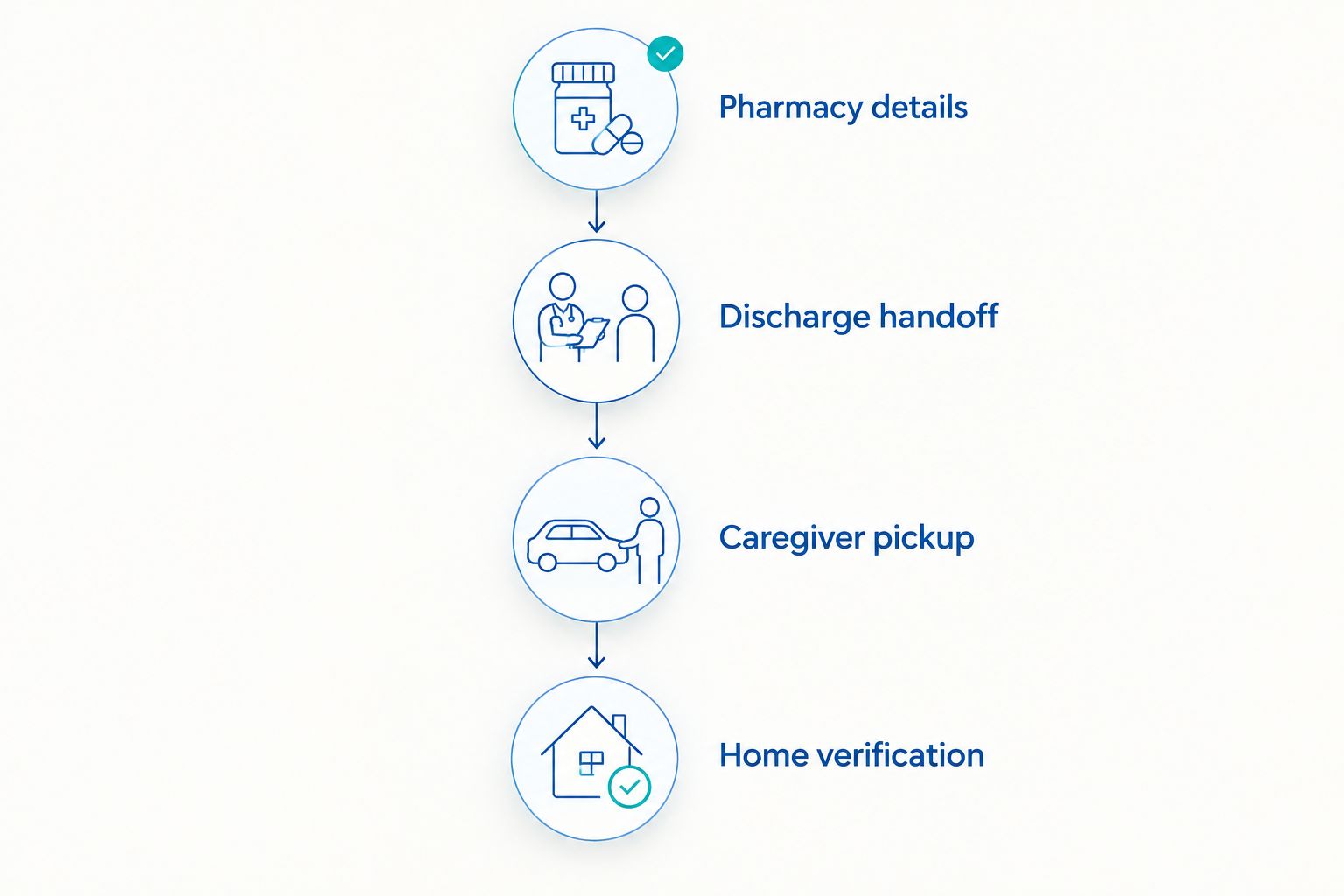
For your 2026 surgery plan, organize the process into 4 stages: pharmacy details, discharge handoff, caregiver pickup, and home verification. This guide organizes those stages; your surgeon’s instructions determine which medications you take and when.
Before you start
- Prepare your medication information. Have your current prescription medications, over-the-counter products, supplements, allergies, and previous medication reactions available for the surgical team and pharmacist. Include medicines you take only occasionally.
- Arrange your caregiver and contact information. Choose a responsible adult for transportation and recovery support. Save 2 contact numbers: the surgical team’s postoperative contact and the dispensing pharmacy’s direct number. Ask how to reach the surgical team after hours.
- Confirm pickup requirements before surgery. Ask the pharmacy what your caregiver must provide, especially for a controlled medication. The non-obvious catch: a prescription that has been sent is not necessarily ready to collect, and a pharmacy notification does not necessarily cover every prescription.
Use this preparation checklist for your 2026 appointment, but confirm the actual prescription timing with your surgical team. Do not start a postoperative medicine before surgery unless the prescriber specifically instructs you to do so.
Stage one: Pharmacy details
- Choose the dispensing location. Give the surgical team the pharmacy’s exact address and phone number. Confirm the location, not just the pharmacy chain; nearby branches are not interchangeable destinations for a prescription.
- Confirm patient details. Check that the pharmacy has your correct name, date of birth, contact information, allergies, and medication list. Tell the pharmacist about relevant updates rather than assuming information from a previous visit is current.
- Ask when prescriptions will be issued. Find out whether your surgical team plans to prescribe before surgery, at discharge, or after a postoperative assessment. Ask which medicines are intended for scheduled use and which are intended only when needed.
- Verify receipt and processing. Contact the pharmacy after the surgical team confirms transmission. Ask the pharmacy to check each prescription individually and explain any clarification needed from the prescriber. Confirm opening hours for the planned pickup day.
Expected result: You and your caregiver know the correct pharmacy, the planned prescribing timeline, and whether anything needs attention before pickup.
Do not assume an app or text message confirms the entire medication plan. Pharmacy systems use different status labels, so ask a direct question: has the pharmacist completed the steps needed for your caregiver to collect each prescribed medicine?
If the pharmacy needs the prescriber to clarify instructions, let the surgical team know before surgery when possible. Your caregiver should not have to interpret an unclear prescription while you are recovering.
Stage two: Discharge handoff
- Review the final medication plan. Ask the discharge nurse or surgical team to explain the medications you will use at home. Confirm whether any medicine prescribed before surgery has been changed or discontinued.
- Record medication given during recovery. Ask for the names and administration times of medicines relevant to your next home dose. Do not estimate the next dose from when you arrived home; medication administered at the facility affects the timing.
- Clarify restrictions and regular medicines. Ask when to resume your usual prescriptions, which nonprescription products to avoid, and whether any prescribed medicines should not be taken together. Follow the individualized plan rather than a generic recovery checklist.
- Have your caregiver repeat the instructions. Ask your caregiver to explain the pickup plan, the first-dose instructions, and the postoperative contact process back to the discharge team. Resolve uncertainty while the team is available.
Expected result: Your caregiver leaves with written instructions and understands what must happen before you take medication at home.
Keep 3 handoff items together: discharge instructions, the current medication list, and the record of medication given during recovery. These documents help the pharmacist and surgical team answer questions without relying on your memory after anesthesia.
Before leaving, tell the team if a prescription problem remains unresolved. Ask for a specific plan for obtaining the medicine and managing symptoms safely. Do not leave an essential medication question for your caregiver to solve without clinical guidance.
The handoff works best when responsibility stays clear: the surgical team directs postoperative treatment, the pharmacist checks dispensing and medication safety, and the caregiver handles collection and records.
Stage three: Caregiver pickup
- Confirm readiness before traveling. Have your caregiver contact the pharmacy and verify which prescriptions are ready to collect. Ask whether another prescription is still being processed or needs prescriber clarification.
- Bring the requested identification. Follow the pharmacy’s instructions for collecting medication on someone else’s behalf. Your caregiver should know your identifying details and carry any documentation the pharmacy has requested.
- Review each dispensed medicine. Ask the pharmacist to explain its purpose, label directions, important interactions, and storage instructions. Have your caregiver raise any difference between the label and your discharge paperwork before leaving.
- Keep recovery supervision intact. Arrange collection without leaving you alone when your discharge instructions require an adult to stay with you. A separate pickup helper is useful when your main caregiver must remain at home.
Expected result: Your caregiver brings home the prescribed medicines with clear instructions and a record of any unresolved issue.
Do not make yourself the backup pharmacy driver after anesthesia or while taking an impairing medicine. A short trip is still driving. Follow the surgical team’s restrictions and arrange another adult if pickup plans change.
Your caregiver can help with logistics, but medication decisions remain with the prescriber and pharmacist. If a medicine cannot be dispensed as written, ask those professionals to coordinate the next step. Do not substitute another person’s medication or use a leftover prescription from an earlier procedure.
Stage four: Home verification
- Compare the bottles with the discharge plan. Check the patient name, medication name, strength, and directions. Keep medicines in their labeled containers so the instructions remain attached to the correct product.
- Resolve conflicting instructions before dosing. If the bottle label and discharge paperwork differ, contact the pharmacist and surgical team. Do not choose whichever instruction seems easier or combine the directions yourself.
- Confirm the first dose. Use the discharge team’s instructions and the record of medication already administered. Ask for clarification if the timing is unclear, especially when a medicine is prescribed only as needed.
- Start a shared medication log. Record the medicine, dose actually taken, time, and any symptoms or side effects. Ask everyone helping with recovery to use the same record to prevent duplicate administration.
Expected result: You have an understandable medication plan, a verified first-dose instruction, and a record your caregiver can maintain.
A medication log records what happened; it does not replace the prescription label. Do not turn an as-needed medicine into a scheduled medicine because a tracking sheet has empty spaces.
Keep medication away from children, visitors, and pets. Ask the pharmacist about storage and disposal, particularly for controlled medicines. Your recovery area should make the correct medication easy to identify without leaving it accessible to others.
Alternative workflow: Pickup before surgery
For a 2026 surgery, ask whether the surgical team can issue any postoperative prescriptions in advance. Early pickup removes a surgery-day errand, but it does not authorize you to begin taking the medicines early.
| Pickup approach | Best for | Main advantage | Limitation |
|---|---|---|---|
| Before-surgery pickup, when the prescriber permits it | Patients whose postoperative prescriptions are finalized before surgery | Gives you time to resolve dispensing questions before recovery | The discharge plan can change, so previously collected medicines need rechecking |
| Caregiver pickup after discharge | Patients whose prescriptions are issued or finalized on surgery day | Lets the caregiver collect medicines after the final instructions are reviewed | Requires coordination between pharmacy collection and recovery supervision |
Choose pickup timing with your surgical team, not by convenience alone. Neither approach removes the need to review the final discharge instructions.
If you collect medicines beforehand, keep them labeled and set them aside until instructed to use them. At discharge, ask whether each medicine still belongs in the current plan. Separate discontinued medicines from the recovery supplies so a helper does not administer them by mistake.
When a prescription changes after surgery, repeat the relevant workflow: confirm the intended pharmacy, verify receipt, review the new directions, and update your medication log. Ask whether the new prescription replaces an existing medicine or adds to the plan.
Troubleshooting prescription pickup
The pharmacy cannot find the prescription
Confirm your identifying details and the exact pharmacy address with both the pharmacy and surgical team. Ask the surgical team to verify where the prescription was sent. Do not assume a different branch can retrieve or dispense it without further action.
The caregiver cannot complete pickup
Ask the pharmacist which identification, authorization, or other requirement remains unmet. Contact the surgical team if the prescription itself needs clarification. Arrange another authorized pickup person without interrupting required recovery supervision.
The medication label conflicts with discharge instructions
Pause and obtain clarification before taking the disputed dose. Have the label, discharge paperwork, and medication-administration record available. Ask for clear instructions and update the home record once the discrepancy is resolved.
Nausea prevents you from keeping medicine down
Contact the surgical team for guidance rather than automatically repeating a dose or crushing a tablet. Some medicines must not be crushed, and redosing after vomiting requires individualized advice. Seek prompt medical assessment for persistent vomiting or inability to keep fluids down.
Pain worsens despite following the plan
Contact the surgical team rather than increasing the dose yourself. Severe or rapidly worsening pain needs assessment, especially with other concerning symptoms. Call 911 for trouble breathing, inability to wake normally, or other signs of a medical emergency.
Customize your recovery workflow
For your 2026 recovery plan, assign named responsibilities rather than assuming everyone will help. Decide who confirms pharmacy readiness, who collects medication, who stays with you, and who maintains the log. When caregivers change, hand over the written instructions and the actual administration record.
Match medication arrangements to the rest of your recovery setup. The guide to preparing your home for tummy tuck recovery helps you organize the space where discharge paperwork and recovery supplies belong.
For Castellano Cosmetic Surgery Center cosmetic surgery patients, the next step is to ask the surgical team about prescription timing during preoperative planning. The practice’s breast, body, and facial procedures require individualized instructions; this workflow does not establish a standard medication regimen for them.
The benefit of a written plan is continuity between helpers. Its limitation is that paperwork becomes outdated when treatment changes. Keep the current instructions together and clearly separate earlier versions.
FAQ
Can someone else pick up my prescription after cosmetic surgery?
A caregiver can collect prescriptions when the pharmacy’s requirements are met. Ask the dispensing pharmacy in advance what identification or authorization it requires, especially for controlled medications.
Should I pick up my postoperative prescriptions before surgery?
Pick them up before surgery only when the prescriber issues them and permits that arrangement. Recheck every medicine against the final discharge plan, and do not start it early unless instructed.
Can I drive to the pharmacy after cosmetic surgery?
Do not drive yourself after anesthesia or sedation, or while taking medication that impairs driving. Follow your surgical team’s driving restrictions and arrange caregiver pickup.
Does a pharmacy text mean all my prescriptions are ready?
A pharmacy notification does not necessarily confirm that every prescribed medicine is ready to collect. Ask the pharmacy to check each prescription individually before your caregiver travels.
What if my prescription label differs from my discharge instructions?
Contact the pharmacist and surgical team before taking the disputed dose. Keep both sets of instructions available so they can resolve the difference and give you a clear plan.
When should I take my first pain medicine after surgery?
Take the first dose according to your individualized discharge instructions. The correct timing depends on the prescribed medicine and medication already administered during surgery or recovery.
What should I ask Castellano Cosmetic Surgery Center before my 2026 procedure?
Ask when postoperative prescriptions will be issued, which pharmacy should receive them, and how your caregiver should handle pickup. Also confirm first-dose instructions, regular medication restrictions, and the postoperative contact process.
One last thing
The most useful entry in your home medication log starts before you get home: the relevant medication given in recovery and its administration time. Ask the discharge team for that information. It connects the facility’s treatment to your first home dose and gives the pharmacist or surgeon something concrete to check when timing is unclear.
Related guides
- How to choose a recovery caregiver for cosmetic surgery in Tampa
- How to manage nausea after anesthesia for cosmetic surgery
- How to manage constipation after cosmetic surgery in Tampa

Author: Dr. Joseph Castellano
Dr. Joseph Castellano is a native Floridian who grew up in the Tampa Bay area. After medical school and residency, Dr. Castellano returned home and has opened a practice in Tampa, Florida focusing on breast augmentation, abdominoplasty, liposuction, facelift, and eyelid rejuvenation. He is a member of the American Board of Cosmetic Surgery, American College of Surgeons, and American Medical Association