A breast implant size chart by cc compares implant volume, not final bra cup size. This 2026 chart covers selected reference volumes from 350 cc to 650 cc and explains how to use them before a breast augmentation consultation in Tampa.
- Use this breast implant size chart by cc to compare volume, not predict bra cup size.
- The selected reference volumes span 350 cc to 650 cc; they are not a recommended range for everyone.
- Castellano Cosmetic Surgery Center offers breast augmentation for Tampa adults seeking personalized aesthetic improvements.
- Compare implant width, profile, and tissue coverage before choosing a volume.
Why this matters
An implant's cc number tells you how much volume it contains. It does not tell you how that volume will look on your chest. Your existing breast tissue, breast width, skin envelope, and implant dimensions all affect the result.
Choose an implant that fits your anatomy and goals, rather than choosing a cup letter and working backward. A chart helps you ask better questions. It cannot replace measurements or a surgical examination.
Breast implant size chart by cc: 2026 reference volumes
Cubic centimeters, abbreviated cc, measure volume. One cubic centimeter equals one milliliter, so a 400 cc implant has a nominal volume of 400 mL. The table compares selected volumes per implant, not the combined volume of both breasts.
| Reference volume | Equivalent volume | Difference from 350 cc | What the comparison establishes |
|---|---|---|---|
| Overall selected range | 350–650 mL | Up to 300 cc more | The span of this reference chart, not a patient average |
| 350 cc breast implants | 350 mL | Reference point | The lowest volume shown here |
| 400 cc breast implants | 400 mL | 50 cc more | More implant volume, without a fixed cup-size increase |
| 450 cc | 450 mL | 100 cc more | A volume comparison, not a prediction of breast width |
| 500 cc | 500 mL | 150 cc more | More volume than the reference point, not a suitability rating |
| 600 cc | 600 mL | 250 cc more | A larger volume that still requires dimensional assessment |
| 650 cc | 650 mL | 300 cc more | The highest volume shown here |
The highest reference volume is 650 cc, and the lowest is 350 cc, a difference of 300 cc per implant. Neither is a winner: a larger number means more implant volume, not a better fit or a more natural-looking result.
Methodology: This 2026 reference chart uses volumes named in Castellano Cosmetic Surgery Center's educational page topics; milliliter equivalents follow the standard metric conversion, and differences are arithmetic comparisons. Its limitation is that it describes volume only—not patient outcomes, manufacturer-specific dimensions, or how frequently surgeons select each size.
How to use these benchmarks
- Read each number as volume per implant. The 400 cc row means 400 mL in an individual implant, not a promised final breast volume.
- Use differences to organize a discussion. The 50 cc difference between 350 cc and 400 cc is measurable, but it does not establish a predictable difference in cup size.
- Compare dimensions alongside volume. A 450 cc implant and a 500 cc implant require their own width and projection measurements before you can judge fit.
- Keep the endpoints in context. The 350–650 cc span is this chart's reference range, not a minimum or maximum for your body.
Why cc does not translate directly into a cup size
Bra cup letters describe the relationship between breast and band measurements within a sizing system. They are not standardized containers for implant volume. Bra construction and fit also differ, so a cup letter is an imprecise surgical target.
Your breast after augmentation includes both your existing tissue and the implant. Someone starting with more breast tissue does not have the same starting point as someone with less tissue, even when both select the same implant volume.
That is why a universal rule such as a set number of cc per cup size is not a dependable planning method. Describe the shape and fullness you want instead of relying on a cup-size conversion. Tell your surgeon whether you want more upper-breast fullness, more projection, or better balance with your proportions.
For your 2026 consultation, bring examples of results you like and explain what appeals to you. A photograph communicates a preference; it does not establish which implant will reproduce that appearance on your body.
Volume, width, and projection answer different questions
Implant volume is only part of the sizing decision. Width describes the implant's footprint, while projection describes how far it extends forward. Profile describes the relationship between these dimensions within a manufacturer's implant range.
| Measurement | What it tells you | Best for | What it cannot establish alone |
|---|---|---|---|
| Volume | How much volume the implant contains | Comparing cc values | Final cup size or breast shape |
| Width | How broad the implant's base is | Assessing anatomical fit | How much forward fullness you will see |
| Projection | How far the implant extends forward | Discussing the desired silhouette | Whether tissue coverage is adequate |
A higher-profile implant is not automatically a larger-volume implant. Different implant designs distribute volume differently, so equal cc values do not guarantee equal dimensions. Compare the actual specifications of the implants under consideration rather than treating profile names as interchangeable across manufacturers.
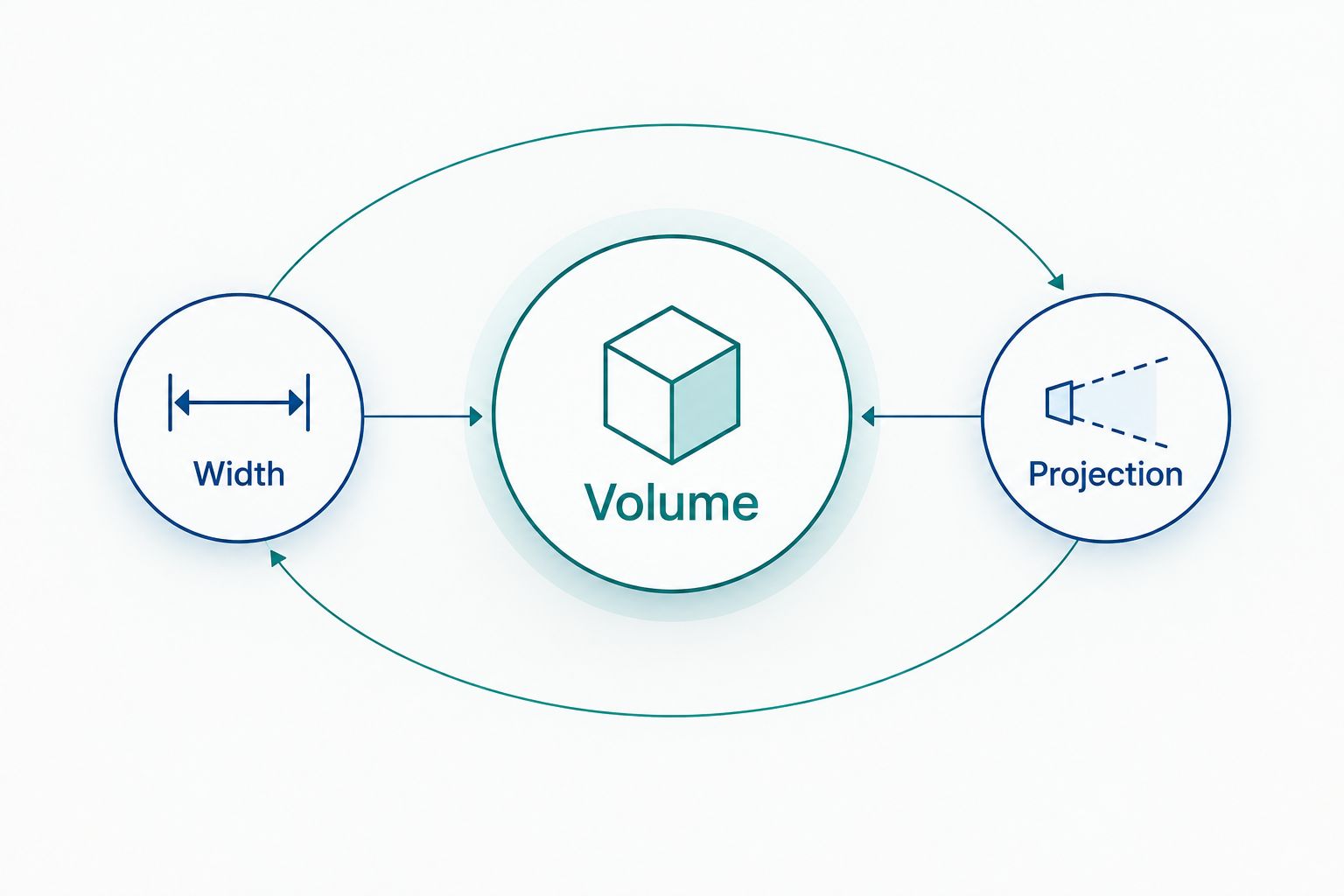
Ask your surgeon to explain how the implant's width relates to your measured breast base. Then discuss projection. This keeps the conversation focused on fit and shape instead of assuming that moving up the cc chart solves every concern.
What makes the same implant volume look different
Existing breast tissue
Your own tissue contributes to breast size and covers the implant. Differences in tissue amount and thickness affect how the implant's contours appear and feel. The same nominal volume therefore produces different results in different patients.
At Castellano Cosmetic Surgery Center, breast augmentation is one of the surgical procedures offered to Tampa adults seeking aesthetic improvements. Your consultation should address your starting anatomy, not just the reference image or cc number you bring.
Chest and breast dimensions
Height alone is not an implant-sizing measurement. Your breast base, chest shape, and the relationship between your breasts provide more useful information about fit.
A volume that appears prominent on one frame can appear less prominent on another. Avoid assigning a fixed size category to every petite, tall, or athletic patient; those descriptions do not replace individual measurements.
Skin envelope and breast position
Breast volume and breast position are separate concerns. An implant adds volume, but it is not a substitute for a lift when repositioning breast tissue and the nipple is needed.
If your main concern is sagging, ask your surgeon to distinguish loss of fullness from changes in breast position. Choosing more cc without addressing that distinction does not create a reliable plan.
Implant placement
Placement relative to the chest muscle changes the tissue covering the implant and affects surgical planning. It also has trade-offs that need discussion alongside your anatomy and activities.
Do not choose placement solely to make a particular volume look smaller or larger. Ask why the proposed placement fits your tissue coverage, shape goals, and examination findings.
Comparing smaller and larger volumes honestly
A lower cc value is not automatically more natural-looking, and a higher cc value is not automatically excessive. Those judgments depend on the relationship between the implant and your body. Use the chart to compare volume, then ask what each anatomically suitable option would change.
| Comparison approach | Best for | Advantage | Limitation |
|---|---|---|---|
| Lower volume within a suitable shortlist | Patients prioritizing less added fullness | Keeps the discussion focused on a more restrained volume change | Can fall short of your desired fullness |
| Higher volume within a suitable shortlist | Patients prioritizing more added fullness | Offers more volume when dimensions and tissues support it | Requires attention to tissue support and dimensional fit |
| Similar volume with different profiles | Patients deciding between silhouettes | Separates forward projection from volume alone | Profile labels do not replace actual measurements |
These are discussion categories, not recommendations for specific cc values. Your surgeon needs to assess which options belong on the shortlist before you compare their appearance.
Breast augmentation also involves risks regardless of volume. The U.S. Food and Drug Administration's patient information on breast implants identifies complications including capsular contracture, rupture, and additional surgery, and states that implants are not lifetime devices. A sizing conversation should include those issues—not stop at the appearance you want.
How to prepare for a sizing consultation
Use your 2026 consultation to turn preferences into an anatomical plan. The most useful preparation is a clear description of what you want to change and what you want to preserve.
Explain your goal without prescribing an implant
Describe the concern first: limited fullness, asymmetry, changes after pregnancy, or proportions you want to adjust. Then describe your preferred result in ordinary language. You do not need to arrive with a final cc choice.
Castellano Cosmetic Surgery Center offers breast augmentation alongside other breast, body, and facial procedures. Ask which approach addresses your concern and whether augmentation alone fits your goals.
Ask for the measurements behind the recommendation
Request an explanation of breast width, tissue coverage, and any asymmetry. Ask how those findings narrow the implant choices. A recommendation becomes easier to understand when you know which anatomical feature it addresses.
If different volumes are proposed for each breast, ask why. Equal implant volumes do not necessarily correct unequal starting anatomy, and unequal volumes do not guarantee perfect symmetry.
Compare suitable options consistently
If your surgeon uses external sizers, compare options in the same bra and clothing. That makes the comparison more useful because you are not changing the garment along with the volume.
External sizers show added fullness outside your body. They do not reproduce implant placement, tissue behavior, or the final surgical result. Treat them as a communication aid, not a guarantee.
Include recovery and follow-up
Ask how the proposed procedure affects recovery planning, activity restrictions, and follow-up. Review the implant's patient information and the FDA patient decision checklist with your surgeon before deciding.
Do not let a preferred cc number override a concern about anatomical fit or surgical risk. A good sizing discussion explains both the expected benefit and the limits of the plan.
FAQ
What does cc mean in a breast implant size chart?
Cc means cubic centimeters, a unit of volume. One cc equals one milliliter, so a 400 cc implant has a nominal volume of 400 mL; the number does not describe its width or your final cup size.
How many cc does it take to increase one cup size?
There is no universal cc-to-cup-size conversion. Your starting breast tissue, band size, implant dimensions, and bra fit all affect the cup size you wear after augmentation.
Is a 400 cc implant much bigger than a 350 cc implant?
A 400 cc implant contains 50 cc more volume than a 350 cc implant. How noticeable that difference looks depends on the implant dimensions and your anatomy, not the volume difference alone.
Are 650 cc breast implants too large?
The 650 cc label alone cannot determine whether an implant is too large for you. A surgeon needs to assess its dimensions against your breast width, tissue coverage, skin envelope, and goals.
Can the same cc size look different on different people?
Yes, the same implant volume can look different on different people. Existing breast tissue, chest dimensions, skin characteristics, and implant placement affect the result.
Is a higher-profile implant always bigger?
No, higher profile does not automatically mean greater volume. Profile describes dimensional proportions within an implant range, so compare volume, width, and projection separately.
Can larger implants replace a breast lift?
Larger implants do not replace a lift when breast tissue and nipple repositioning are needed. A surgeon must distinguish a concern about fullness from a concern about breast position.
What should I bring to a breast implant sizing consultation in 2026?
Bring your goals, relevant medical history, and photographs that help explain your preferred shape. Ask the surgeon to connect those preferences to your measurements, suitable implant dimensions, and surgical risks.
One last thing
Ask to see the dimensions of the proposed implant, not just its cc value. That simple request turns a volume preference into a discussion about width, projection, and fit.
For your 2026 planning, Castellano Cosmetic Surgery Center's breast augmentation information is most useful as preparation for an individualized consultation. Keep the chart as a vocabulary guide—not a prescription for your body.
Related guides

Author: Dr. Joseph Castellano
Dr. Joseph Castellano is a native Floridian who grew up in the Tampa Bay area. After medical school and residency, Dr. Castellano returned home and has opened a practice in Tampa, Florida focusing on breast augmentation, abdominoplasty, liposuction, facelift, and eyelid rejuvenation. He is a member of the American Board of Cosmetic Surgery, American College of Surgeons, and American Medical Association