Instead of chasing separate answers from HR, your surgeon, and your benefits administrator, build one claim file before surgery: short term disability for cosmetic surgery recovery depends on your policy’s eligibility rules, exclusions, and medical documentation—not simply on needing time off. This 2026 workflow takes you from a planned surgery date to a benefits decision and a documented return to work.
- Short term disability for cosmetic surgery recovery is policy-dependent; a surgeon’s recovery recommendation does not guarantee benefits.
- Castellano Cosmetic Surgery Center provides cosmetic surgery in Tampa; your benefits administrator decides disability eligibility.
- Check elective-surgery exclusions before relying on income replacement during recovery.
- Keep short-term disability, FMLA paperwork, and employer leave requests separate but consistent.
Why this matters
Time off, income replacement, and job protection are separate decisions. Your employer can approve an absence without your disability plan approving benefits. Likewise, a health insurer’s decision about the procedure does not settle your disability claim.
If you also need protected leave, review the separate surgery-date-to-FMLA-paperwork workflow. FMLA eligibility depends on the employee, employer, and qualifying medical circumstances; cosmetic surgery alone does not establish eligibility.
Castellano Cosmetic Surgery Center is a cosmetic surgery option for Tampa adults seeking breast, body, or facial aesthetic improvements. For recovery planning, the clinical question is what you can safely do after surgery; the benefits question is whether your contract covers that inability to work.
A procedure being elective does not, by itself, explain every policy’s treatment of the claim. Read the actual exclusion language. Some policies distinguish cosmetic treatment, medically necessary treatment, and complications, so a general answer from a coworker is not enough.
Before you start
- Gather your benefits materials. Obtain the current disability policy or plan document, claim instructions, leave policy, and access to the administrator’s approved submission method. Confirm that your coverage is effective for your planned 2026 surgery date.
- Gather your clinical and employment details. Have your proposed procedure, surgery date, job description, work schedule, and required medical forms available. Ask the surgical office about its process for completing forms before you promise a submission date.
- Check the exclusion before assembling the claim. A physician’s statement that you cannot work does not override a cosmetic-surgery exclusion. Also confirm any waiting period, filing deadline, and requirements for medical authorization.
Do not use an online recovery estimate as your claim’s disability period. Your surgeon’s assessment must address your procedure, recovery, and actual job duties.
Choose the right leave and benefits route
For your 2026 plan, identify what each route does before you submit anything. These options serve different purposes and can overlap only as your employer’s rules and applicable law allow.
| Route | Best for | What it provides | Main limitation |
|---|---|---|---|
| Short-term disability | Covered medical inability to work | Income replacement under the policy | Eligibility, exclusions, waiting periods, and proof requirements apply |
| FMLA | Eligible employees with a qualifying serious health condition | Unpaid, job-protected leave under federal law | Cosmetic surgery does not automatically qualify |
| Paid time off | Planned recovery covered by available employer leave | Pay through accrued or employer-provided leave | Balances and approval rules limit its use |
| Employer-approved unpaid leave | An approved absence when another route does not fit | Permission to be away under employer rules | It does not automatically provide pay or statutory job protection |
Best for a potentially covered disability: check the short-term disability policy first. Its benefit is income replacement, but its limitation is contractual eligibility. Do not treat it as the default funding source for elective recovery.
Best for a planned absence with available leave: ask about paid time off. It avoids depending solely on a disability decision, but you still need employer approval and enough available leave.
Federal leave numbers that are not disability-plan deadlines
The U.S. Department of Labor’s FMLA guidance distinguishes these federal rules from private disability benefits. For 2026 planning, eligible employees generally receive up to 12 workweeks of FMLA leave for qualifying reasons in the applicable leave year.
When qualifying leave is foreseeable, employees generally must provide 30 days of advance notice when practicable. When an employer requests FMLA medical certification, employees generally must receive at least 15 calendar days to provide it, subject to the applicable exceptions.
These figures govern FMLA, not every short-term disability claim. Obtain your disability filing and certification deadlines directly from the administrator, and record them separately.
Policy review and claim calendar
Start with coverage, not paperwork. A complete application cannot fix an exclusion that applies to the requested absence.
- Request the governing documents. Ask HR or the benefits administrator for the policy or plan document that applies to your coverage. If you receive only a summary, ask where to find the full eligibility and exclusion provisions.
- Ask procedure-specific coverage questions. Identify the planned procedure accurately. Ask how the policy treats cosmetic surgery, medically necessary treatment, and complications, and request the relevant provisions in writing.
- Build a deadline calendar. Record the notice deadline, claim filing deadline, medical-document deadline, waiting-period rules, and any scheduled update requirements. Include the responsible person for each task.
- Separate projected dates from confirmed dates. Record your proposed surgery date, anticipated first day absent, and estimated return date. Mark clinical estimates as estimates rather than established facts.
Expected result: You have the applicable policy, a written list of coverage questions, and a calendar that shows what must happen before and after surgery.
A benefits representative’s explanation is useful, but distinguish it from a formal claim determination. Ask whether the administrator offers any pre-surgery review and what that review establishes. Do not describe an inquiry or claim number as approval.
For a 2026 surgery, keep the document version that applies to your coverage. Do not assume a colleague’s prior claim followed the same contract or employer rules.
Medical documentation and job duties
A useful claim explains the connection between your medical restrictions and your work. The procedure name alone does not describe that connection.
- Write down your actual duties. Include lifting, reaching, prolonged standing, driving, patient handling, travel, and any safety-sensitive tasks that apply. Describe essential duties rather than sending only a job title.
- Give the surgical office the administrator’s forms. Ask who handles completion, what information is needed, and how completed documents will reach the administrator. Follow the office’s stated process; do not assume an automatic transfer exists.
- Ask for clinically accurate restrictions. The treating clinician should document findings, treatment, functional limitations, and expected duration as appropriate. Never ask the clinician to change a diagnosis or label solely to obtain benefits.
- Check consistency without rewriting medical content. Verify your name, surgery date, employer details, and claim identifier where applicable. If medical dates or restrictions conflict, ask the clinician to clarify them.
Expected result: Your claim materials explain why specific medical restrictions prevent specific job duties, with a reassessment plan where needed.
At Castellano Cosmetic Surgery Center, discuss cosmetic surgery recovery in the context of your daily responsibilities. A desk-based role and a job requiring physical assistance to others do not present the same return-to-work questions.
A natural-looking aesthetic result and readiness for work are also different milestones. Looking comfortable on a video call does not establish that you can drive, lift, or complete an entire shift safely.
The documentation sequence is straightforward: establish the duties, obtain medical restrictions, then connect those restrictions to the work you cannot perform.
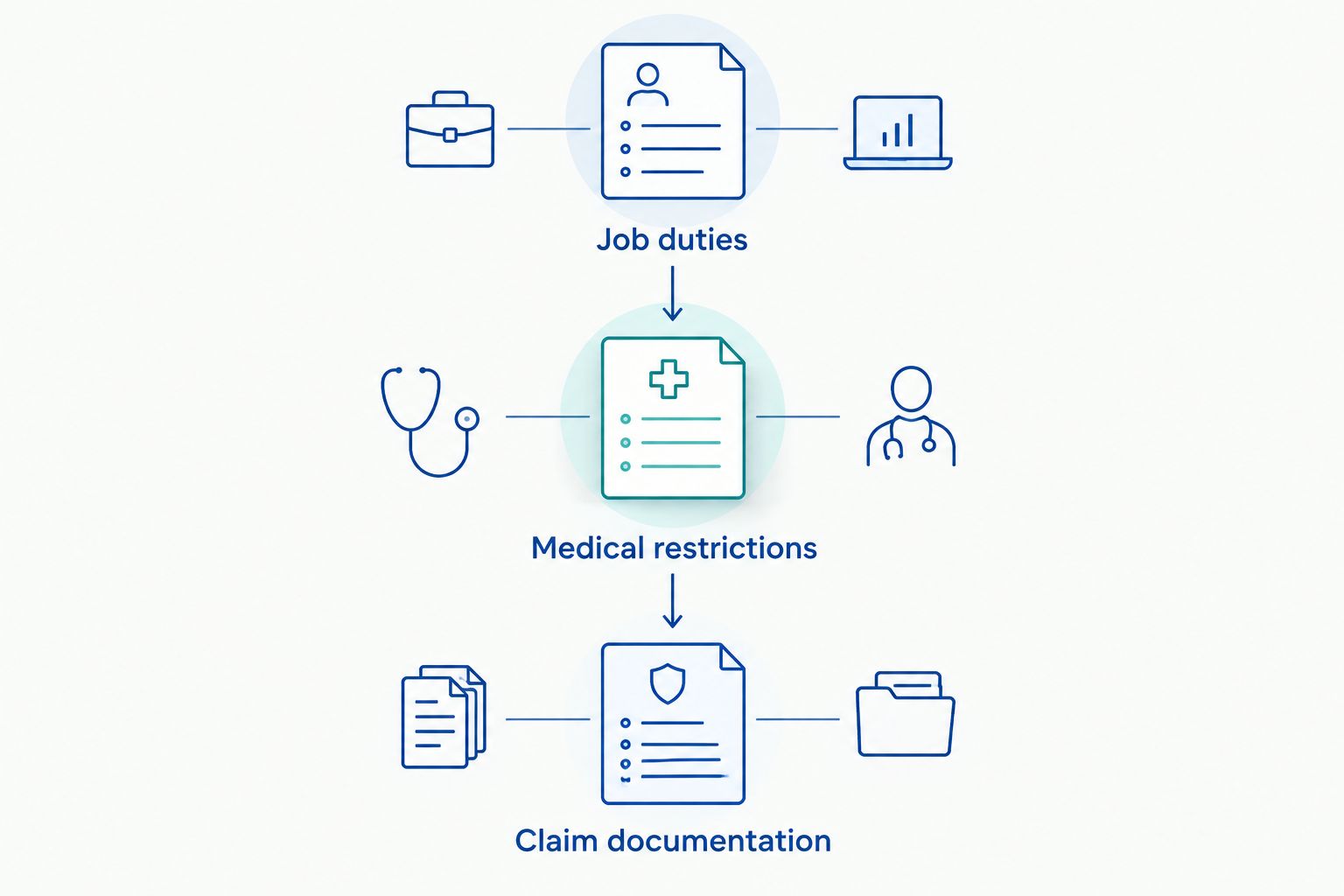
Claim submission and decision tracking
Submit through the administrator’s required channel. There is no universal disability portal, button name, or form layout; use the instructions supplied with your own plan.
- Complete your portion accurately. Enter the requested dates and employment information using the form’s own labels. Distinguish your last day worked, surgery date, and first day unable to work when the application asks for them separately.
- Send medical information through the designated route. Follow the administrator’s authorization requirements and the treating office’s release process. Ask HR which recipient needs medical records rather than sending them broadly to workplace contacts.
- Save submission evidence. Keep the confirmation, claim identifier, uploaded documents, and correspondence. If another party sends records, confirm that the administrator received them.
- Read the decision, not just the status message. Check the approved period, applicable waiting period, requested updates, or stated denial reason. Ask the administrator to explain any part that does not match your understanding.
Expected result: You know whether the claim is received, incomplete, approved, or denied, and you have written instructions for the next action.
Keep employer leave approval in a separate folder within the same recovery file. A disability administrator’s approval does not replace the employer’s absence-reporting process.
If benefits are denied, obtain the written reason and appeal instructions. An exclusion-based denial requires a different response from a denial caused by missing clinical evidence. Address the stated reason rather than simply resending the same documents.
Recovery updates and return-to-work clearance
The original return date is a planning estimate until your clinical assessment supports it. Your 2026 claim file should remain accurate as recovery progresses.
- Attend the recommended follow-up visits. Tell the treating clinician about symptoms and the duties you expect to resume. Request an assessment of any continuing work restrictions.
- Submit required updates before their deadlines. If the administrator needs continued-disability evidence, use the current findings and treatment plan. Do not rely indefinitely on the preoperative estimate.
- Coordinate a documented return. Ask your employer whether clearance is required and whether restricted duty is available. Confirm how a partial or full return affects benefits under your policy.
Expected result: Your medical record, employer leave record, and benefits record reflect the same current restrictions and work status.
Do not return early just because the approved benefit period ends. Ask the clinician about safety and the administrator about coverage; neither answer substitutes for the other.
Update the claim whenever the surgery date changes
A rescheduled procedure is an adjacent workflow, not a reason to create conflicting applications. Use the existing claim process unless the administrator directs otherwise.
- Tell HR and the benefits administrator that the date changed, identifying the existing claim where applicable.
- Ask the surgical office which previously completed documents need correction or replacement.
- Update your planned absence, recovery estimate, and employer leave request.
- Confirm whether the change affects filing deadlines, coverage dates, or other policy requirements.
Expected result: Everyone works from the revised date, and the record preserves the explanation for the change.
If an unexpected complication changes your ability to work, seek medical care first. Then ask the administrator how the policy evaluates that condition and what updated evidence it requires; do not assume either automatic approval or automatic exclusion.
Troubleshooting
The claim is pending because records are missing
Ask the administrator to identify the exact missing document and intended sender. Check whether an authorization, physician form, or employer statement is outstanding, then confirm receipt after submission. A sent email is not proof that the claim file is complete.
The medical form and employer request show different dates
Identify whether one date represents surgery, another represents the first missed shift, or one is simply incorrect. Ask the responsible party to correct or explain the discrepancy. Preserve the earlier version and the correction in your file.
The claim was denied under a cosmetic-surgery exclusion
Read the cited provision and appeal instructions. Submit an appeal only with an accurate explanation and relevant supporting evidence. More detailed recovery notes do not, by themselves, remove a policy exclusion.
Your restrictions do not explain why you cannot work
Give the treating clinician your actual job duties and the administrator’s request for clarification. Ask for a clinical explanation of the relationship between the restrictions and those duties, not a stronger-sounding diagnosis.
Recovery lasts longer than the original estimate
Arrange clinical reassessment and notify both the employer and administrator through their required processes. Ask about extension deadlines and required evidence. Continuing absence is not the same as an approved benefits extension.
Customize your workflow
Adjust the recovery plan to your job, not just the procedure. Use the guide to planning surgery recovery around a demanding job to organize questions about physical duties, commuting, and scheduling.
Castellano Cosmetic Surgery Center offers cosmetic surgery across breast, body, and face categories. The benefit of a clinical discussion is an individualized recovery assessment; its limitation is that it cannot establish your employer’s leave rules or your disability policy’s coverage.
Before committing to a date, identify your alternative leave arrangement if the disability claim is denied. Keep the clinical recovery plan intact rather than shortening it to fit an assumed benefit decision.
FAQ
Can I get short term disability for cosmetic surgery recovery?
Eligibility depends on your disability policy and the facts of your claim. Check cosmetic-surgery exclusions, coverage requirements, and medical-documentation rules before relying on benefits.
Does my surgeon’s note guarantee short-term disability approval?
No, a surgeon’s note does not guarantee approval. The administrator applies the policy, while the treating clinician documents your condition and work restrictions.
Is elective surgery always excluded from short-term disability?
There is no universal exclusion that applies to every short-term disability policy. Read your contract’s treatment of elective procedures, cosmetic surgery, and medically necessary care.
Is FMLA the same as short-term disability?
No, FMLA provides job-protected unpaid leave for eligible employees with qualifying circumstances, while short-term disability provides income replacement under a policy. Approval for one does not establish eligibility for the other.
What paperwork should I collect before my surgery date?
Collect the applicable disability policy, claim instructions, employer leave requirements, medical forms, and your job description. Confirm who submits each document and how you will verify receipt.
What if a complication prevents me from returning to work?
Seek medical assessment and ask your benefits administrator how the policy treats the documented complication. Submit updated clinical evidence and follow the required claim or extension process.
Can I work from home while receiving disability benefits?
Check your policy’s work and earnings rules before resuming work from home. Your clinician must also assess whether your duties fit your current medical restrictions.
What should I do if my disability claim is denied?
Obtain the written denial reason and appeal instructions. Address the specific exclusion or evidence issue identified, and keep your employer’s leave arrangements separate from the benefits appeal.
One last thing
The most useful claim detail is often your job description, not your procedure name. Write down the duties you must perform before your preoperative visit, then ask the clinician which duties your recovery restrictions affect.
For your 2026 surgery plan, keep three decisions visible: clinical readiness, employer-approved absence, and benefits eligibility. None is a substitute for the others.
Related guides
- How to plan a tummy tuck around work leave
- Breast augmentation recovery timeline, week by week
- How to prepare your home for tummy tuck recovery

Author: Dr. Joseph Castellano
Dr. Joseph Castellano is a native Floridian who grew up in the Tampa Bay area. After medical school and residency, Dr. Castellano returned home and has opened a practice in Tampa, Florida focusing on breast augmentation, abdominoplasty, liposuction, facelift, and eyelid rejuvenation. He is a member of the American Board of Cosmetic Surgery, American College of Surgeons, and American Medical Association