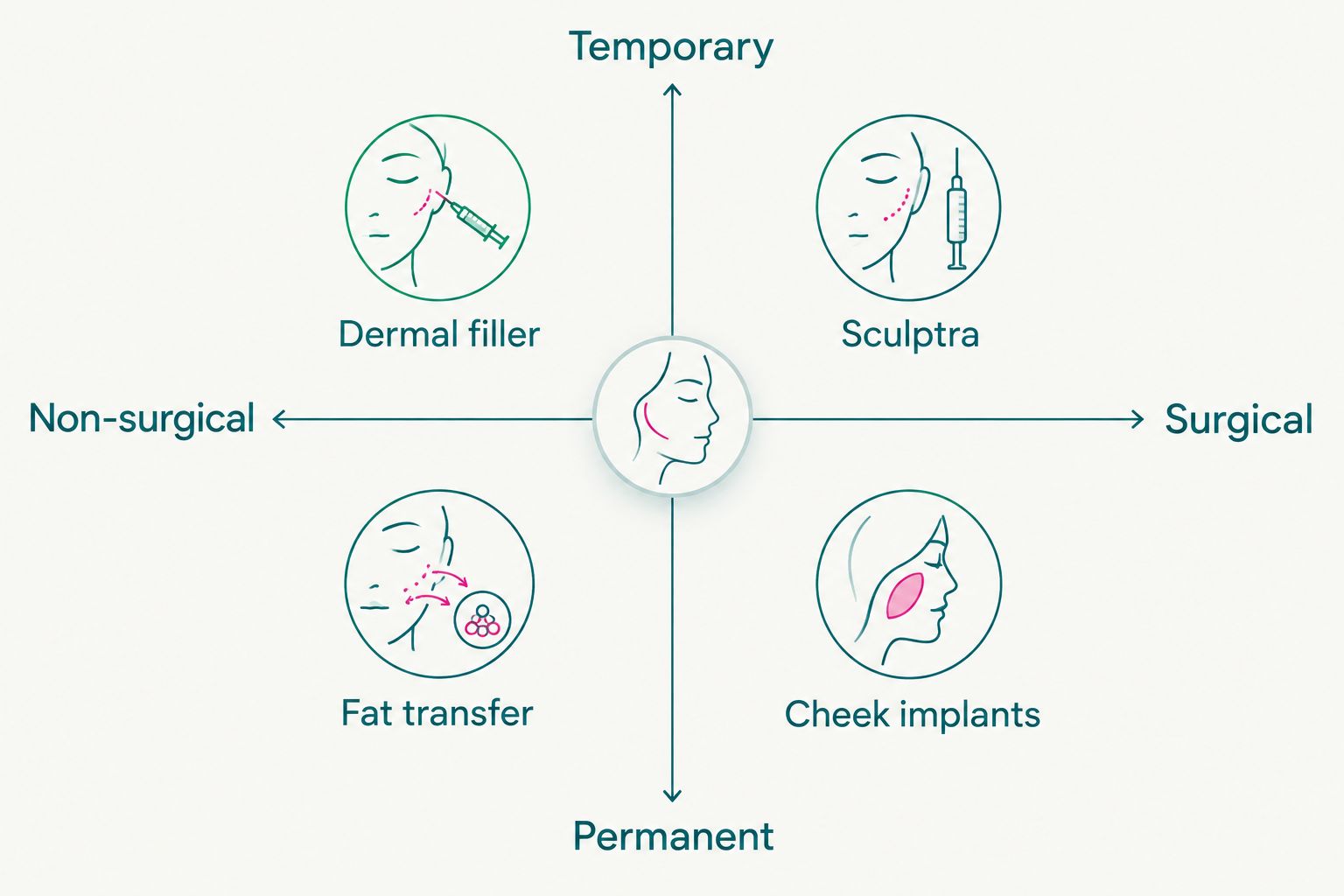
Cheek augmentation in Tampa comes down to four real options, and picking the wrong one means paying for a result that doesn't match what you actually wanted. Best overall for most patients: dermal filler such as Juvederm Voluma — reversible, built in one office visit, no incisions. Best for permanent correction: cheek implants placed surgically. Best for natural augmentation using your own tissue: fat transfer to the face. Best for gradual volume building without a foreign implant: Sculptra collagen stimulator.
- Dermal filler (Juvederm Voluma) is the best cheek augmentation option in Tampa for patients who want results today with zero downtime.
- Cheek implants deliver the only permanent structural change among the four options compared here.
- Fat transfer to the face uses your own tissue and avoids synthetic material entirely, but results are less predictable than filler or implants.
- Sculptra builds volume gradually over months rather than instantly, which suits patients who want a subtle transition.
- Filler vs implants isn’t a single decision — it depends on how permanent, how invasive, and how fast you want the change.
Why this matters
Most people searching "cheek filler vs implants" have already decided they want more cheek projection — the real question is which delivery method fits their timeline, budget tolerance for maintenance, and appetite for surgery. Filler and Juvederm for cheek volume get the most search volume because they're low-commitment, but that doesn't make them the right pick for every face shape or every long-term goal.
An implant placed once in your 30s can outlast two decades of maintenance filler appointments. A patient who isn't ready for surgery but wants meaningful volume for a wedding six months out is better served by a series of filler or Sculptra sessions. In 2026, the four approaches available at Castellano Cosmetic Surgery Center in Tampa cover nearly every version of that decision.
What makes the best cheek augmentation option
- Longevity — how long the result holds before it needs to be repeated or is permanent
- Reversibility — whether an unwanted result can be dissolved or removed
- Recovery time — days of visible swelling or bruising versus weeks
- Material — synthetic filler, a solid silicone implant, or your own fat cells
- Onset — instant correction versus a gradual build over months
- Candidacy — how much your face shape and existing bone structure matter to the outcome
Cheek augmentation options at a glance
| Option | Best For | Standout Feature | Key Limitation |
|---|---|---|---|
| Dermal filler (Juvederm Voluma) | Fast, reversible correction | FDA-approved to last up to two years per treatment | Needs repeat sessions to maintain |
| Sculptra | Gradual, subtle volume build | Stimulates your own collagen over 3-4 months | Results take months to fully appear |
| Fat transfer to the face | Natural augmentation with your own tissue | No synthetic material anywhere in the face | A portion of transferred fat reabsorbs over time |
| Cheek implants | Permanent structural change | One surgery, no repeat maintenance | Requires incisions and a real recovery period |
1. Dermal filler: best cheek augmentation for fast, reversible results
Cheek filler built on hyaluronic acid, most commonly Juvederm Voluma, restores lost volume or adds projection in a single appointment. It's injected directly over or near the cheekbone and the effect is visible immediately, with final settling over about two weeks. Juvederm Voluma is FDA-approved to last up to two years, though most patients in Tampa's heat and activity level see closer to 12-18 months before a touch-up.
Dermal filler pros:
- Results visible the same day
- No incisions, no general anesthesia
- Fully reversible with an enzyme if you don't like the outcome
- Minimal downtime — most patients return to normal activity within 24-48 hours
Dermal filler cons:
- Not permanent — needs repeat sessions to maintain volume
- Overfilling can look unnatural if injected without attention to facial proportion
- Cost adds up over years of maintenance compared to a one-time surgical option
Best for: patients who want to test cheek augmentation before committing to anything permanent, or who need results before a specific date.
Verdict: Recommended for most first-time cheek augmentation patients in Tampa.
2. Sculptra: best cheek augmentation for a gradual, subtle build
Sculptra is a collagen-stimulating injectable, not a direct filler — it works by triggering your own collagen production over several weeks rather than adding immediate volume. Full results typically build over 3-4 months and multiple sessions are usually needed to reach the target volume. That slow build is either the biggest advantage or the biggest drawback depending on what a patient wants.
Sculptra pros:
- Volume looks progressively more natural because it's your own collagen, not a gel sitting under skin
- Results reported to last longer than traditional hyaluronic acid filler in many patients
- Subtle change appeals to patients wary of an obvious "done" look
Sculptra cons:
- Not instant — patients disappointed by slow onset should look elsewhere
- Requires more than one session to reach full effect
- Reversal isn't as simple as dissolving hyaluronic acid filler
Best for: patients planning months ahead who want volume that builds naturally rather than appears overnight.
Verdict: Recommended if your timeline isn't urgent and you want a gradual transition.
3. Fat transfer to the face: best cheek augmentation using your own tissue
Fat transfer to the face removes fat from another part of your body via liposuction, purifies it, and reinjects it into the cheeks. Because the material is your own tissue, there's no synthetic product anywhere in the face — a genuine draw for patients who want to avoid injectable fillers or implants entirely.
Fat transfer pros:
- Zero synthetic material in the final result
- Doubles as light liposuction at the donor site
- Surviving fat cells behave like permanent tissue once they've taken
Fat transfer cons:
- A portion of transferred fat is reabsorbed by the body, so results are less predictable than filler
- Requires a donor-site procedure, adding recovery time on two fronts
- Not a same-day, walk-in option like filler
Best for: patients who specifically want to avoid synthetic filler or implant material and don't mind a more involved procedure.
Verdict: Recommended for patients prioritizing an all-natural approach over speed.
4. Cheek implants: best cheek augmentation for permanent correction
Cheek implants are solid silicone forms placed surgically over the cheekbone, typically through a small incision inside the mouth or near the lower eyelid. Unlike every other option here, implants don't require maintenance sessions once healed — the change is structural and permanent.
Cheek implant pros:
- Permanent — no repeat appointments for years to come
- Predictable, symmetric results because the implant shape is fixed
- Addresses significant bone deficiency that filler alone can't correct
Cheek implant cons:
- Requires surgery, anesthesia, and a real recovery window measured in weeks, not days
- Not reversible without a second surgery
- Carries surgical risks that injectables don't, including infection or implant shift
Best for: patients with genuine cheekbone deficiency who want a one-time, permanent solution and are comfortable with surgery.
Verdict: Recommended for patients certain they want a permanent structural change.
How we ranked these cheek augmentation options
Each option was measured against the same six criteria: longevity, reversibility, recovery time, material used, how fast results appear, and how much candidacy depends on your existing bone structure. No option wins on every criterion — that's the point. Filler wins on reversibility and speed, implants win on permanence, fat transfer wins on material, and Sculptra wins on a natural gradual build.
“Filler vs implants isn’t about which is better — it’s about how permanent and how invasive you’re actually willing to go.”
Which cheek augmentation option should you choose?
If you're undecided, start with dermal filler. It's reversible, gives you an immediate preview of more cheek projection, and doesn't commit you to anything permanent. Patients who like the look after a filler cycle or two and want to stop paying for maintenance are the ones who typically move on to cheek implants. Patients who want the change but object to synthetic material on principle are better served by fat transfer, and patients with no urgency at all often prefer Sculptra's slower, subtler build.
A consultation is still the only way to know which of these fits your face shape, because bone structure changes the calculation for every option on this list.
Compare cheek augmentation options in person
A consultation covers which option fits your face shape and goals.
FAQ
What’s the best cheek augmentation option in 2026?
Dermal filler such as Juvederm Voluma is the best cheek augmentation option for most patients in 2026 because it’s reversible and delivers results in a single visit. Patients who want a permanent change without repeat appointments are better matched to cheek implants.
Is cheek filler better than cheek implants?
Cheek filler is better for patients who want reversible, low-commitment results, while implants are better for patients who want a one-time permanent correction. Neither is universally better — the right choice depends on how permanent you want the change to be.
How long does cheek filler last compared to implants?
Cheek filler like Juvederm Voluma is FDA-approved to last up to two years, though many patients need a touch-up around 12-18 months. Cheek implants are permanent and don’t require repeat treatment once healed.
Does fat transfer to the face last as long as filler?
Fat transfer results can last longer than filler once the transferred fat has taken, but a portion of the injected fat is reabsorbed by the body in the months after surgery. Results are generally less predictable than hyaluronic acid filler.
Is Sculptra a good alternative to cheek implants?
Sculptra is a reasonable alternative for patients who want gradual volume without surgery, but it doesn’t match the permanence or the structural correction that implants provide. It works best for subtle, progressive volume building over 3-4 months.
Are cheek implants safe?
Cheek implants carry standard surgical risks including infection, asymmetry, or implant shift, which is why they should only be placed by a board-certified surgeon. For patients with a genuine cheekbone deficiency, the permanence often outweighs the added surgical risk.
Can you combine cheek filler and fat transfer?
Filler and fat transfer are not typically combined in the same area at the same time since both add volume through different mechanisms. A surgeon evaluates your face shape at consultation to recommend one primary approach.
How do I know if I need filler or implants for cheek augmentation?
If you’re unsure how permanent you want the change to be, start with filler since it’s reversible and gives you a preview of added cheek volume. Patients who confirm they want a permanent result after trying filler often move to implants next.
One last thing
The order patients usually move through these four options tells you more than any comparison chart: most start with filler, some graduate to implants once they know they want permanence, and a smaller group skips straight to fat transfer because they never wanted synthetic material in their face to begin with. Whichever path you're on in 2026, the decision that matters most isn't filler vs implants in the abstract — it's whether you want to commit to permanent now or preview the look first.
Related guides

Author: Dr. Joseph Castellano
Dr. Joseph Castellano is a native Floridian who grew up in the Tampa Bay area. After medical school and residency, Dr. Castellano returned home and has opened a practice in Tampa, Florida focusing on breast augmentation, abdominoplasty, liposuction, facelift, and eyelid rejuvenation. He is a member of the American Board of Cosmetic Surgery, American College of Surgeons, and American Medical Association